


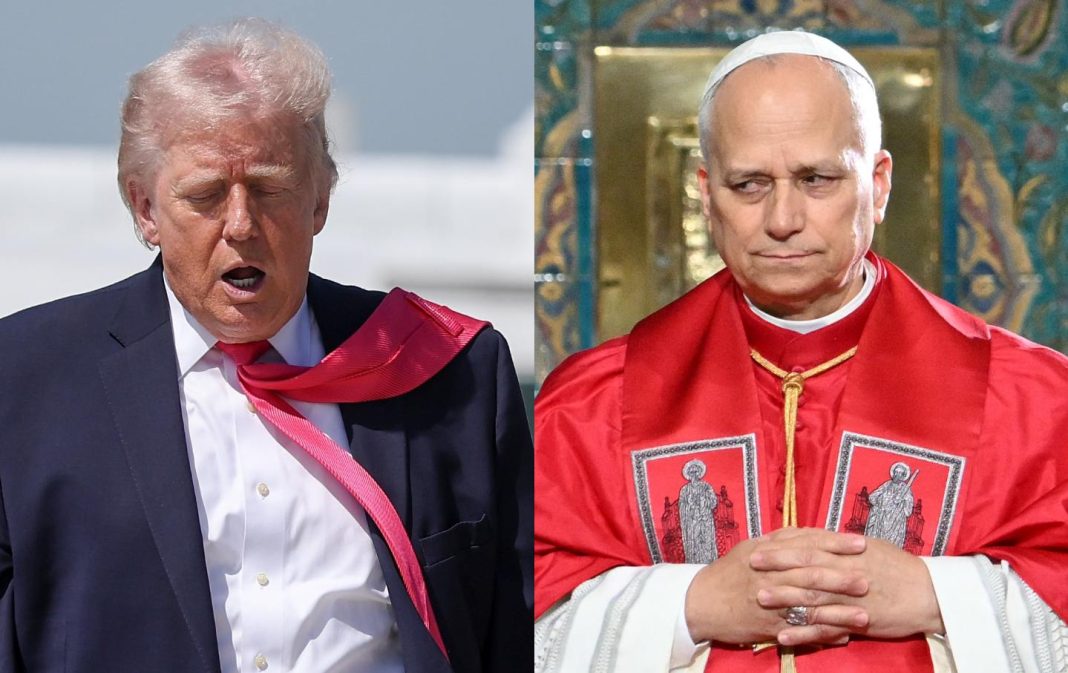

Forget being a regular king. Trump is clearly expressing a not-so-secret desire to be a spiritual monarch.
The two popes???
(Win McNamee / Getty Images ; Alberto Pizzoli / AFP via Getty Images)
Donald Trump’s harshest critics accuse him of being an aspiring king, but recent religious controversies make clear that the president could have even higher ambitions: to be a spiritual monarch and perhaps even the King of Kings.
In early March, Trump asserted that he should have a say in picking the replacement of Iranian Supreme Leader Ayatollah Ali Khamenei, who had been assassinated by the US as part of the regime-change war Trump launched. Trump’s desire to name a new ayatollah might seem absurd, but it is part of a larger pattern of using US military might to subdue rival regimes and religions into submission.
In January, the Pentagon requested a meeting with Cardinal Christophe Pierre—the Vatican’s then-ambassador to the US—for a meeting. The Free Press reported that Pierre had to endure “a bitter lecture warning that the United States has the military power to do whatever it wants—and that the [Catholic] Church had better take its side.” According to The Free Press, one Pentagon official even reportedly brought up the historical example of the Avignon Papacy, a 14th-century crisis where for nearly seven decades successive popes were forced to live in France under the thumb of the French crown.
Other reporting on the meeting cast some doubt on whether the Avignon Papacy was mentioned, although not definitively. Whatever the case, the January meeting was clearly an attempt to intimidate the Catholic Church, and specifically Pope Leo XIV. It fits into a long pattern of Trump and his allies trying to cow the Vatican. Leo’s predecessor, Pope Francis, Francis, was intensely hated by the MAGA right, who often derided him as a “woke pope” for his criticism of environmental degradation and economic inequality. In 2019, Steve Bannon, the former Trump advisor, allied with the late Jeffrey Epstein, a power broker and notorious convicted pedophile, in efforts to undermine Pope Francis and bolster traditionalist opposition factions inside the church.
Leo has disappointed right-wingers who hoped for a return to the hard-line conservatism of Francis’s predecessor, Benedict XVI. Born in the United States, Leo lived for many years in Peru, where he served as bishop from 2015 to 2023. This has given him an empathy with the Global South that runs through his frequent criticisms of militarism. In a speech in Cameroon on Thursday, the pope condemned the “handful of tyrants” ravaging the world and rebuked those “who manipulate religion in the very name of God for their own military, economic or political gain, dragging that which is sacred into darkness and filth.” In addition, Leo has called for governments to treat migrants and refugees humanely.
While the pope has not named Trump directly in these messages, the president has clearly felt their sting. This explains Trump’s Truth Social Post last Sunday that claimed “Pope Leo is WEAK on Crime, and terrible for Foreign Policy.” Trump returned to this topic on Thursday, telling reporters that the pope “says Iran can have a nuclear weapon. I say Iran cannot have a nuclear weapon.” Trump, as he so often does, is lying. As CNN reports, “Pope Leo hasn’t made any statement saying Iran can have a nuclear weapon. In fact, the pope has repeatedly denounced nuclear weapons and made unequivocal calls for the countries of the world to abandon them.”
Current Issue
Vice President JD Vance, who converted to Catholicism in 2019 at age 35, has found a niche for himself as the official White House attack dog against the Vatican (though Trump now appears to be competing for that title). For some reason, Vance has chosen to do this by presenting himself as a bigger expert on Catholicism than the pope. As Tom Nichols of The Atlantic notes, Vance
could have taken his cues from John F. Kennedy or Mario Cuomo, Catholic politicians who were careful to note that their faith was personal and important to them, but that in their public life, they must govern as Americans according to the Constitution. Vance decided on a different approach: The pope, he implied, wasn’t a very good, or very smart, Catholic.
Lecturing the pope on theology might smack of hubris, but it is an outgrowth of an even more arrogant idea: that Trump himself is a holy figure. In a now-deleted Truth Social Post, Trump shared an AI image of himself in the role of Jesus healing the sick. In response to the backlash that the image was blasphemous, Trump deleted the post and offered the dubious defense that he thought the picture merely showed him as a doctor healing the sick (despite the fact that it was replete with religious iconography).
What shreds the credibility of Trump’s defense is that the idea that he is near Christ-like is not uncommon in MAGA circles. When Trump first emerged in politics in 2015, evangelical Christians who admired him would often compare him to King David, an admittedly flawed man given to sexual excesses who nonetheless was an instrument of God’s will. But as these Christians have gotten used to Trump, the King David analogy has given way to comparisons with Christ. In other words, Trump is no longer seen as a necessary evil but as a positive embodiment of good.
At an Easter event in the White House, Paul Caine-White, the president’s spiritual adviser, said, “And Mr. President, no one has paid the price like you have paid the price. It almost cost you your life. You were betrayed and arrested and falsely accused. It’s a familiar pattern that our lord and savior showed us.” On Thursday, Representative Troy Nehls said Trump was “almost the second coming.” That same day, Defense Secretary Pete Hegseth compared “the legacy Trump-hating press” to the biblical Pharisees who “scrutinized every good act in order to find a violation, only looking for the negative.” Implicit in this analogy is that Trump is like Jesus, the good man the Pharisees persecuted.
The idea of Trump as Jesus is of course something that only cultists can believe. MAGA in its most intense form does resemble a cult. Trump-as-Jesus is also a theology of authoritarianism. It implies that Trump cannot be criticized. This explains the frenzied MAGA attacks on Pope Leo. Even those of us who are not Catholic or Christian can recognize the church as an autonomous institution with a right to up hold its own value and vision of the world. But Trump can’t abide any powerful institution outside his control. The authoritarian tendencies of MAGA make it plausible that the Avignon Papacy was invoked in the January meeting. Perhaps the next logical step is, as some have suggested, an American Avignon Papacy, with Mar-a-Lago as a new Vatican. When Pope Francis died in 2025, Trump was quick to post an AI image of himself sitting on the throne of Peter in full papal regalia. That was a troll, of course, but like many of Trump’s trolls, it spoke to a hidden desire.