



Viktor Orbán’s defeat is just the latest example of the administration’s European ambitions’ being stymied.
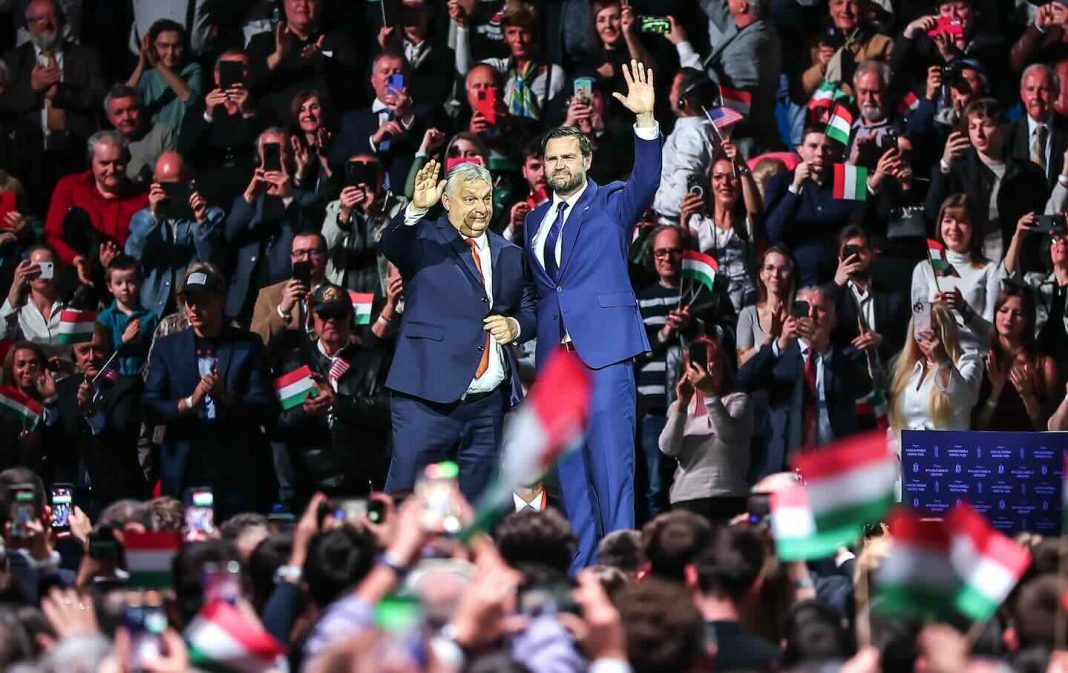
Hungarian Prime Minister Viktor Orbán and US Vice President JD Vance at a campaign rally for the prime minister in Budapest, Hungary, on April 7, 2026.
(David Balogh / Xinhua via Getty Images)
Five days before Hungarian voters threw Viktor Orbán to the curb, in the most significant setback to global far-right forces since Jair Bolsonaro’s 2022 reelection loss in Brazil, JD Vance staked what dwindling political capital he has left on the Hungarian autocrat’s reelection.
In an act of astonishingly overt election interference, Vance flew into Hungary on April 7 for a quick bout of campaigning on behalf of the OG of hard-right populism and his Fidesz party. Now, there’s nothing new about US officials using covert tactics to influence political events and elections overseas; leaders around the world do this, and certainly Americans have been no exception. But historically there has been something of a tacit understanding that, at least in public, one denies such sordid activities; after all, it doesn’t look good when a country avowedly committed to democratic ideals and the principle of self-determination shrugs off those ideals at the first opportunity. Under this administration, however, the gloves have been removed. When Trump officials want to secure a political outcome overseas, they do so openly, shamelessly, with not even a hint of awareness—or care—that this impinges on the sovereignty of other countries and their populaces.
Standing next to Orbán at campaign rally events, Vance praised the prime minister to the rafters, and even put Trump on speakerphone to also shower superlatives on Orbán, before slamming the European Union for what he called “one of the worst examples of foreign election interference” and accusing the Brussels bureaucracy of attempting “to destroy the economy of Hungary.” The Guardian’s headline writers had some fun with it all: “JD Vance accuses the EU of ‘interference’ as he visits Hungary to help Orbán win election.”
That Vance’s mission ended in such spectacular failure is, of course, the icing on the cake. Far from helping Europe’s most reliable MAGA ally, Vance’s appearance may have further crystallized the stakes in play for voters in Hungary. After all, the election wasn’t just about whether Orbán had been in office too long; it was also about whether Hungary should ally with the autocracies of Putin’s Russia and Trump’s America over its European neighbors. By their millions, Hungarians chose Europe.
When the votes were tallied, the opposition had won two-thirds of the seats in parliament—a margin so large that even Orbán couldn’t ignore it; he conceded, calmly, peacefully, within hours of the polls closing, on Sunday. For Trump, who has pushed the narrative that if populist right candidates lose it can only be because of fraud, Orbán’s meek departure from the spotlight must be particularly galling.
There is a serious lesson to be learned from the Fidesz party’s crushing electoral defeat, and from the Trump administration’s abject failure to secure the result it so desperately wanted in Hungary.
Having been all too publicly stymied in his aims at a quick in-and-out aerial assault operation in Iran, Trump has been lashing out ever louder against any and all European institutions, which he seems to blame, without distinction, for the fiasco he finds himself in in the Middle East. On a near-daily basis, he attacks NATO, threatening to pull the US out of the alliance, and accuses America’s treaty allies of cowardice and of abandoning the nation in its moment of need in the Strait of Hormuz. This week, after a month of relentless sallies against British Prime Minister Keir Starmer and mockery of the country’s military, Trump all but declared the US-UK special relationship dead, called the country’s immigration policies “insane,” and warned that he could choose to scrap the carefully worked-out trade deal between the two countries. When he’s not been making apocalyptic threats to destroy Iranian civilization, or publishing AI-generated images of himself as a Christ-figure, Trump has lambasted the Spanish and French leadership in starkly personal terms, fallen out with his erstwhile ally Italian far-right Premier Giorgia Meloni, and, in a twist bizarre even by this administration’s surreal standards, gone to verbal war against the pope—months after Pentagon officials reputedly implied to the papal representative in the US that they could take action to depose the pope and install an alternative far from the Catholic Church’s power-center of Rome.
Trump has also resurrected his fixation on Greenland, referencing the island in bizarre comments and online posts. “It all began with, if you want to know the truth, Greenland,” Trump told reporters last week, referring to his escalating dispute with NATO allies. “We want Greenland. They don’t want to give it to us. And I said, ‘bye, bye.’”
Throughout his senescent presidency, Trump has also made clear his all-consuming disdain for the supranational project of the European Union, and for the blending of races and cultures that it epitomizes. He has called the continent “decaying,” and warned in starkly racist tones that it faces “civilizational erasure” because of immigration.
And yet, even as Trump’s propaganda machine cranks up the anti-European rhetoric, it appears that the MAGA administration’s ambitions to bend Europe to its will are being stymied. The attacks on the UK have led to a rash of recent moves by the British government to start drawing closer to the EU, 10 years after the calamitous Brexit vote. French President Macron, who has long attempted to maintain cordial relations with the snarling Trump administration, finally gave up and told Trump he had to “be serious.” In Germany, even the neo-Nazi AfD, surging in the polls and beloved by the Trump administration, has formally come out against the war in Iran, and has even gone so far as to suggest that all US bases in the country should be closed down.
Trump has attempted to impose a MAGA agenda on the whole of Europe, and points beyond. Instead, as the economic disruptions triggered by the Iran war pick up speed, Europe is coalescing against the Donroe Doctrine’s increasingly bizarro sense of manifest lunacy. After his election win, the new Hungarian leader, Peter Magyar, pointedly said that he would not be phoning Trump, though if Trump chose to call him, he would make himself available. It was a none-too-subtle announcement that another European leader has joined the growing club of political figures who no longer see the need, or the point, in playing sycophant to Trump’s increasingly off-the-rails presidency.
Trump wants to export his crude and cruel brand of politics worldwide. Yet the more he rants the less appealing that political project seems to the rest of the world. In fact, in what must surely rank as one of the speediest collapses in global ratings ever recorded, fewer people around the world now approve of the US’s global leadership role than approve of China’s. Among US neighbors, only 22 percent of Canadians and 15 percent of Mexicans have confidence in Trump’s doing the right thing on the world stage. In country after country, a majority of voters express distrust in Trump’s role as a world leader.
Trump just keeps on losing. And, as we have seen over the past couple weeks, when a megalomaniac such as Donald Trump is exposed as nothing more than a repeat loser, the puncturing of his myth of invincibility may drive him entirely crazy.