



As Trump continues to dismantle federal agencies, this state shows what happens when a one-party-controlled government makes sweeping public health changes with little resistance.
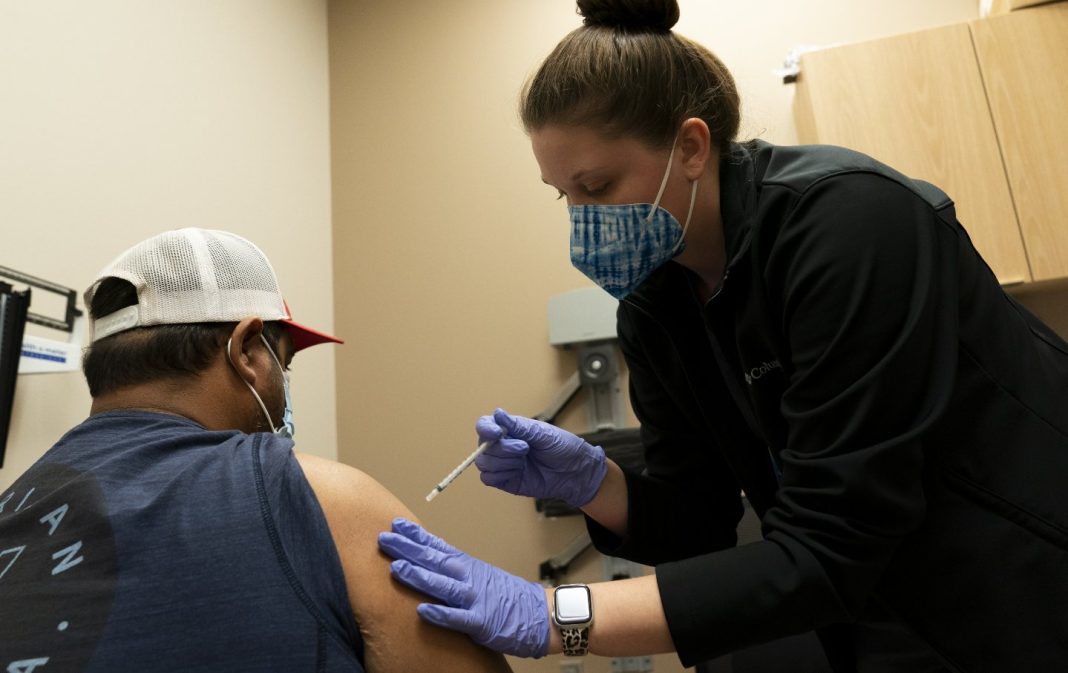
A healthcare worker administers a Covid-19 vaccine at an Oklahoma County Health Department Vaccine Clinic.
(Nick Oxford / Getty)
In early 2021, employees at Oklahoma’s new “state-of-the-art” Public Health Laboratory in Stillwater found expensive lab equipment at their workstations, but not enough free electrical outlets. Instead of a smooth opening, they were greeted with slow Internet service and an early power outage. By September, federal inspectors at the laboratory found things hadn’t improved: virus samples stored in an unlocked refrigerator, boxes of expired reagents stacked at entrances, and rows of empty desks.
The lab also lacked specialized personnel, forcing some tests out-of-state to Minnesota as workers reportedly mishandled Covid-19 samples and use of expired materials for screening. One worker warned that the move to the new lab was a “hurried, thoughtless decision that needs reconsideration and more planning.”
For Janis Blevin’s family, the rushed move also meant five weeks of “worry and concern” after her granddaughter’s newborn screening was processed through the Stillwater lab. In interviews, Blevin and her daughter, Lori Zehnder, described how the newborn was subject to five blood draws, two catheter urine collections, and five doctor’s appointments in the very first frantic weeks of life due to a false positive for Malonic Acidemia. “Those first six weeks were rough without having to add on something that could have been easily avoided if someone had taken the necessary steps to make sure things were done correctly,” Zehnder told KFOR.
Much of this largely avoidable disarray is the natural result of a one-party state testing the boundaries of administrative power and opacity. Oklahoma’s Republican-controlled government has made sweeping administrative decisions with almost no resistance—a “perfect storm,” according to Lori Freeman, CEO of the National Association of County and City Health Officials. Overlapping state and federal funding withdrawals have led to cuts, closed-door decision-making, a lack of oversight, and confused patients, all of which threatens “the ability to provide what is needed to keep communities safe and healthy.”
Families in Oklahoma, like the Blevins, have felt the consequences of these decisions firsthand. In 2025, the state’s healthcare system was ranked 49th—nearly the worst in the nation—by the Commonwealth Fund. Mothers and children have been hit the hardest, with women facing a 25 percent higher mortality rate from 2020 to 2021, as the live birth death rate is nearly seven points above the national average. “Workforce shortages existed well before the pandemic, but the past three years have strained hospital resources like never before,” writes the Oklahoma Hospital Association. And in rural areas, it’s even worse.
Now, just one year into his term, President Trump and his administration are attempting something similar on a national scale. They have fired and re-hired workers across departments, leaving key management positions vacant including the chief medical officer and the head of the Office of Public Health Data. Since taking office, nearly $1 billion has been cut from ongoing pandemic-preparedness R&D. Health Secretary Robert F. Kennedy Jr.’s promotion of anti-vaccine policy and conspiracy-based rhetoric have added to the compounding chaos in the nation’s preventive health systems.
Current Issue

Rather than working to improve public health outcomes, the Trump administration has treated experts as adversaries to be undermined and weakened. “With fewer experts at our nation’s leading health agencies, Americans will suffer more preventable diseases,” according to Dr. Robert Steinbrook, director of the Public Citizen Health Research Group, “and more unsafe drugs and medical devices will be marketed.”
What should Americans expect from a system that intentionally lacks basic accountability and oversight? A slowdown of preventive measures, increased reliance on corporate labs, the dismantling of biodefense programs, possible destruction of stockpiles of vaccines, and unpredictable swings in guidelines and subsidies (as is already happening with Obamacare).
Oklahoma has continued to drastically reduce its public health spending. Along with the state’s refusal of the ACA subsidies, the Oklahoma’s Division of Government Efficiency returned nearly $157 million in federal healthcare grants it deemed “wasteful,” which effectively rolled back programs such as supplemental immunization funding, community health workforce initiatives, and impactful public health lab services, including newborn screening and epidemiological surveillance.
The state has a long-standing opposition to federally funded public health measures, even if it means rejecting billions in grants and aid, and Oklahoma was one of the first states to refuse to create a federally mandated state insurance exchange. Recently, the governor worked to draw more right-wing ideological lines by issuing an executive order to terminate Medicaid providers that are referred to or were affiliated with abortion services, going so far as to mandate providers to attest that they would stand by the “pro-life” standard.
State Senator Paul Rosino, chair of the Senate Health and Human Services committee, noted that the state expects a shortfall of nearly $700 million to $1 billion in Medicaid and SNAP from federal grants, with no clear alternative for supplemental medical programs and leaving many without full healthcare access.
In 2020, when Governor Kevin Stitt decided the public health laboratory needed a change of scenery, the agency had already “experienced some legislative resistance to the move to Stillwater,” according to internal e-mails. Rather than improving the deteriorating OKC lab, the Stitt administration decided to push through the move, as state officials wished to have the deal “in place sooner rather than later,” hoping to finalize the move before lawmakers and voters could intervene. At the time, changing the lab was confusing, and, in hindsight, even more so.
Popular
“swipe left below to view more authors”Swipe →
Along with the faulty lab, the Stitt administration promised a collaborative “Oklahoma Pandemic Center of Innovation and Excellence.” According to Dr. George Monks, former head of the Oklahoma State Medical Association, the center was created to test emerging variants of coronavirus. Yet, as of April 2022, state officials described the center as still “a work in progress,” despite the hiring of a CEO, executives, and a private company to manage the center. Posting on X, Monks attributed the center to being a “$30 million ghost,” noting that its website went offline on March 30, 2023, despite a grand ribbon-cutting.
A lack of oversight from bipartisan forces and surrounding advisers is what allowed Oklahoma to make these ill-advised decisions, and it is what will allow the Trump administration to continue pulling apart the American healthcare system.
If the structure of the state’s system takes hold nationally, the unified federal health infrastructure that has supported families in the United States won’t exist for much longer. In simple terms, residents in California, Oklahoma, or New York will have radically different access to vaccines, outbreak alerts, reproductive care, and diagnostic tests.
Red states will build one healthcare model, while blue states will build another. And if the creation of this fractured system continues to lack resistance, reunifying healthcare and establishing national standards might become an impossible task.
More from The Nation
Widespread unrest as crackdown intensifies, leaving thousands dead.
America should build things again, and we the people should own what we build.
In November, the governor issued a proclamation declaring CAIR, the country’s largest Muslim civil rights and advocacy group, a terrorist organization. “It’s about sowing suspicio…
But Tom Homan is a lying liar, and the work’s not done. Plus, Gallup’s sketchy new polling policy (is the analytics firm in the Trump tank?), the law for deepfakes, and more in th…