


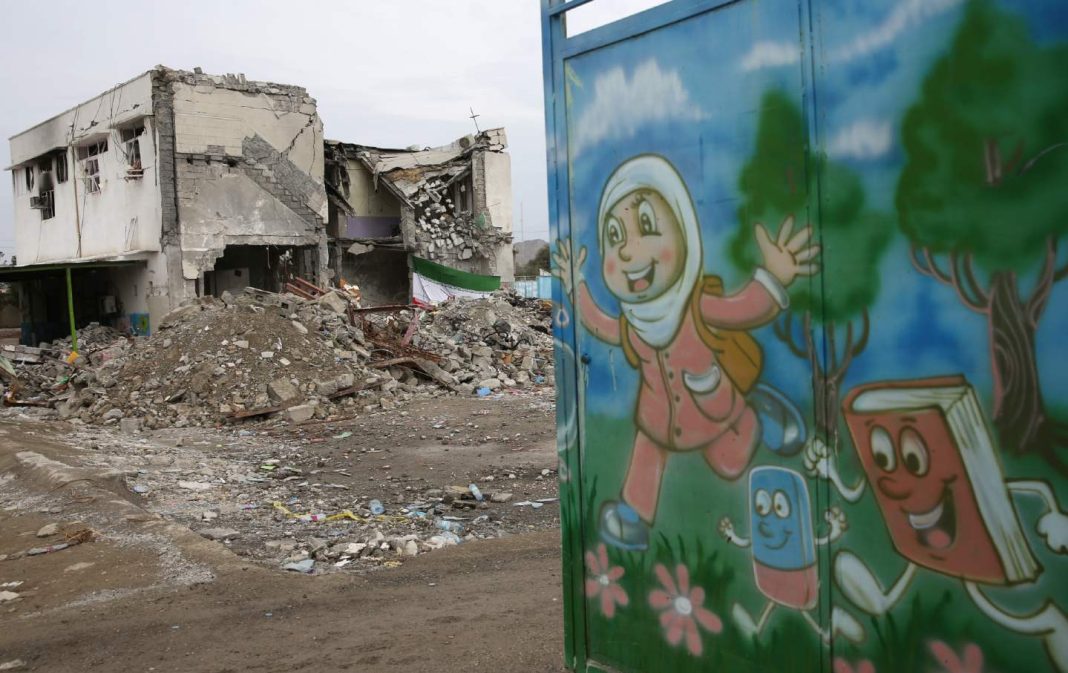

Under Trump, the US is unequivocally a force for evil in the world. It can seem morally intolerable to embrace happiness as our government massacres children.
The destroyed building of Shajarehâ’ye Tayyibe Primary School is seen after a US-Israel strike in Minab that killed 185 people, including dozens of students and teachers, most of them children, in Hormozgan, Iran, on March 21, 2026.
(Hassan Ghaedi / Anadolu via Getty Images)
Iwas on a family hike when I learned that our country had obliterated the Shajareh Tayyebeh girls’ elementary school in Minab, Iran. Using Tomahawk missiles developed and produced with the taxes that you and I pay, the United States executed a double-tap strike—a tactic designed to kill emergency responders—that murdered at least 168 people. Most of the victims torn apart by these US bombs were 7-to-12-year olds. Later reporting would describe the scene of the massacre: “children’s bodies lying partly visible” under the rubble, a “very small child’s severed arm” being pulled from the debris.
I thought of a sketch from the British comedy duo Mitchell and Webb. The bit opens on a bunker with two SS officers. One walks worriedly over to the other. “Hans, I’ve just noticed something,” the Nazi says nervously. “Have you looked at our caps recently?”
“Our caps?”
“The badges on our caps, have you looked at them?”
Current Issue

“What? No. I don’t…”
“They’ve got skulls on them,” the Nazi interrupts. “Have you noticed that our caps have actually got little pictures of skulls on them?” He pauses, looking anxious. Then he asks the question that’s become immortalized in meme form: “Hans… are we the baddies?”
Trump’s nihilistic war on Iran is not the first disaster that’s made me think the United States might be a baddie. My first time cursing our government was when George W. Bush officially killed the Kyoto climate treaty. As a freshman in high school, I marched against the war in Iraq. I’m used to thinking of the United States as a dangerous actor on the world stage.
And yet, that was never all we were. There were always redeeming qualities. These counterpoints are exactly what the Trump regime has spent the last year stripping away—ending lifesaving international aid programs, clawing back the Inflation Reduction Act’s climate investments, blowing up any remaining commitments to democratic principles and international law.
And then came the war on Iran. There’s just no way to tell a story in which a character launches a surprise attack on an elementary school during a busy school day—tearing apart tiny bodies that were just hours earlier hugging parents and grandparents and siblings—and not have that character be the baddie.
In my algorithmic circles, there was a genre of social-media post that would pop up every few months during the course of Israel’s war on Gaza. Someone would share a picture of Israelis enjoying themselves—maybe a clip of a busy Tel Aviv beach full of good-looking young people sunbathing or playing matkot. And then someone else would repost the image with some version of the caption, “This is The Zone of Interest,” a reference to the Oscar-winning 2024 film by Jonathan Glazer.
The Zone of Interest depicts Rudolf Höss, the commandant of the Auschwitz concentration camp, and the disquietingly banal domestic life he and his family enjoyed in their flower-filled estate located just outside the walls of the Nazi’s most infamous extermination camp. At various points in the movie, we see telltale signs of the horrors being committed next door—a plume of crematoria smoke visible through the bedroom window, a stream of ash flowing into the river in which Rudolf and his kids are paddling, a distant rat-tat-tat of gunfire on the other side of the garden wall that only the family’s dog seems to notice. But throughout the film, the focus of the camera remains squarely on the Höss family and the cheerful life they insist on living in the shadow of humanity’s most evil crime.
It’s a disturbing movie to watch, and intentionally so. As Glazer said in his Oscar acceptance speech, “All our choices were made to reflect and confront us in the present—not to say, ‘Look what they did then’; rather, ‘Look what we do now.’”
Though Glazer was clear—and courageous in his moral clarity—about the applicability of his film to the genocide in Gaza, I always had a conflicted reaction when I’d see those “crowd of happy Israelis = Zone of Interest” posts. On the one hand, part of me would think, “Well, wait, some of these people probably oppose what’s happening in Gaza. Are they really not allowed to enjoy a day in the sun because their government is committing war crimes that they’re not in a position to stop?” But another part of me would recoil at this joyful embrace of life. “If my country were directly committing atrocities, I hope I’d at least have the good grace to be deeply depressed about it,” I’d think.
Well, here we are.
Of course, we shouldn’t make false equivalencies. What’s happening in Iran right now is not, or at least not yet, as damnable as what happened in Gaza. And none of these abominations even come close, in quantitative terms, to the catastrophe of the Holocaust. But the kaleidoscope of nightmares that our government is conjuring today—the children attempting suicide in federally run concentration camps, the hundreds of thousands of deaths caused by the shutdown of USAID, the unadulterated malevolence of White House propaganda videos that intersperse actual kill-shot footage from Iran with clips from Braveheart and Gladiator—is enough to make the United States of a kind with depravities of the past.
So the question remains: Are we obligated to at least have the good grace to be depressed? Is it acceptable to embrace happiness when surrounded by so much evil?
There’s a short story by Anton Chekhov that grapples with precisely these questions. The story, “Gooseberries,” has a very simple plot: Two men out hunting are forced by a rainstorm to seek shelter at a friend’s estate; they arrive just as the friend is bathing in his pond; all three have a swim; then, while they are lounging together after dinner, one of the visitors, Ivan, argues to his friends that the embrace of happiness in a world of suffering is wrong.
In this passage, Chekhov has Ivan deliver a profound statement:
“We see those who go to the market to buy food, eat during the day, sleep during the night, who talk their nonsense, get married, grow old, complacently drag their dead to the cemetery; but we don’t see or hear those who suffer, and the horrors of life go on somewhere behind the scenes. Everything is peaceful and quiet and only mute statistics protest: so many people gone out of their minds, so many gallons of vodka drunk, so many children dead from malnutrition. And such a state of things is evidently necessary; obviously the happy man is at ease only because the unhappy ones bear their burdens in silence, and if there were not this silence, happiness would be impossible. It is a general hypnosis. Behind the door of every contented, happy man there ought to be someone standing with a little hammer and continually reminding him with a knock that there are unhappy people, that however happy he may be, life will sooner or later show him its claws, and trouble will come to him—illness, poverty, losses, and then no one will see or hear him, just as now he neither sees nor hears others. But there is no man with a hammer. The happy man lives at his ease, faintly fluttered by small daily cares, like an aspen in the wind—and all is well.”
So what does it mean to realize your country is the baddie? What are the obligations of a citizen of such a nation? Obviously there’s a responsibility to do what we can to oppose the vile acts of our state—to vote against our current government, to protest its war, to work to hold our leaders accountable. But what about in between the moments when we can take useful action? My immediate question—standing there in the woods, caught between the nightmarish fact of those murdered children and the reality of my own kids getting farther and farther up the trail ahead—was how can one justify living a full and happy life in such a morally intolerable context?
What’s perhaps most interesting to me, reading this passage in the year 2026, is that we actually do have the option now—in a way Chekhov never could have imagined while writing those words in 1898—of enlisting our own personal man with a hammer, in the form of X or Instagram or TikTok. Depending on your algorithm, scrolling across these social media platforms can be a continual reminder that there are unhappy people; that our government is blowing up children and raining cancer down on civilians and reveling in that violence and destruction. Meanwhile, I’m out here enjoying the fresh air on a hike, looking for a good spot for the family to picnic.
What might Chekhov have thought of such doomscrolling? Certainly one could read the above passage and confidently conclude that here is a Russian literary genius firmly on team “be depressed.” But in “Gooseberries,” it’s not actually clear what Chekhov’s position on Ivan’s man-with-a-hammer strategy really is. I mentioned that before we get to the big moralizing speech at the heart of his story, Chekhov’s three characters bathe in a pond—a scene that the author George Saunders named his lovely 2021 book A Swim in a Pond in the Rain after. And who do you think Chekhov has enjoying that swim the most?
Ivan went outside, plunged into the water with a splash, and swam in the rain, flinging his arms out wide. He stirred the water into waves which set the white lilies bobbing up and down; he swam to the very middle of the millpond and dived, and came up a minute later in another place, and swam on, and kept on diving, trying to touch the bottom. “By God!” he kept repeating delightedly, “By God!” He swam to the mill, talked to the peasants there, then returned and lay on his back in the middle of the pond, turning his face to the rain. The others were dressed and ready to go, but he still went on swimming and diving. “By God!” he kept exclaiming. “Lord, have mercy on me!”
Well now! Pond Ivan doesn’t sound like a guy who believes that embracing joy in a world of suffering is all bad. Chekhov seems to say through his character’s conflicted relationship with happiness that yes, there’s a connection between ignoring suffering and maintaining it, and likewise between the embrace of happiness and the avoidance of the unhappy—but at the same time, it’s a wonderful thing to jump in a pond and dive to the bottom and lie on your back while the rain falls, and why should we deny ourselves that experience?
So how do we reconcile these contradictory feelings? The easy answer is moderation—a Middle Way that steers clear of extremes on either end. But I’m not sure moderation is really what this moment calls for. We should feel sadness and anger at the actions of our government—and honestly there should be an extremity to those feelings. The horrors being committed in our name merit—demand, even—some extremes. At the same time, unrelenting misery will not motivate action—and action should be the ultimate goal here. The hero in The Zone of Interest isn’t a Nazi who, unlike the Hösses, has the good grace to be depressed. Rather, it’s a Polish girl—based on a real person, Alexandra Bistron-Kotodziejczyk, whom Glazer dedicated his Oscar to—that the film shows sneaking up to Auschwitz in the dead of night, hiding apples across a worksite for the starving prisoners to find the next day. In Glazer’s words:
“That small act of resistance, the simple, almost holy act of leaving food, is crucial because it is the one point of light. I really thought I couldn’t make the film at that point. I kept ringing my producer, Jim, and saying: ‘I’m getting out. I can’t do this. It’s just too dark.’ It felt impossible to just show the utter darkness, so I was looking for the light somewhere, and I found it in her. She is the force for good.”
Popular
“swipe left below to view more authors”Swipe →
The objective for each of us is to be a force for good, to create some light in the darkness. Perhaps, as Glazer found, that requires finding some light for ourselves, to keep things from getting too dark. Maybe it even justifies an intense embrace of those lighter moments—a jump in the pond, as Chekhov envisioned.
Which brings me back once more to our hike. Standing paralyzed on the snow-dusted trail, scrolling, I didn’t look up from my phone, even as my 5-year-old turned around to shout, “Hurry up, Dad!” My country had just murdered dozens of children. Now was not the time for family fun.
A minute later, he shouted again, even louder, “DAD! It’s picnic time.” And this time the words punched through the fog in my head. Indeed, my stomach grumbled, a reminder that as sad as I was, I was also hungry. I dropped my phone back into my pocket and hurried up the trail. Because my son was right, of course. It was picnic time.
Even before February 28, the reasons for Donald Trump’s imploding approval rating were abundantly clear: untrammeled corruption and personal enrichment to the tune of billions of dollars during an affordability crisis, a foreign policy guided only by his own derelict sense of morality, and the deployment of a murderous campaign of occupation, detention, and deportation on American streets.
Now an undeclared, unauthorized, unpopular, and unconstitutional war of aggression against Iran has spread like wildfire through the region and into Europe. A new “forever war”—with an ever-increasing likelihood of American troops on the ground—may very well be upon us.
As we’ve seen over and over, this administration uses lies, misdirection, and attempts to flood the zone to justify its abuses of power at home and abroad. Just as Trump, Marco Rubio, and Pete Hegseth offer erratic and contradictory rationales for the attacks on Iran, the administration is also spreading the lie that the upcoming midterm elections are under threat from noncitizens on voter rolls. When these lies go unchecked, they become the basis for further authoritarian encroachment and war.
In these dark times, independent journalism is uniquely able to uncover the falsehoods that threaten our republic—and civilians around the world—and shine a bright light on the truth.
The Nation’s experienced team of writers, editors, and fact-checkers understands the scale of what we’re up against and the urgency with which we have to act. That’s why we’re publishing critical reporting and analysis of the war on Iran, ICE violence at home, new forms of voter suppression emerging in the courts, and much more.
But this journalism is possible only with your support.
This March, The Nation needs to raise $50,000 to ensure that we have the resources for reporting and analysis that sets the record straight and empowers people of conscience to organize. Will you donate today?