

April 8, 2026
In his recent military budget, Trump is saying the quiet part out loud: Waging war is more important to his administration than providing for basic needs at home.
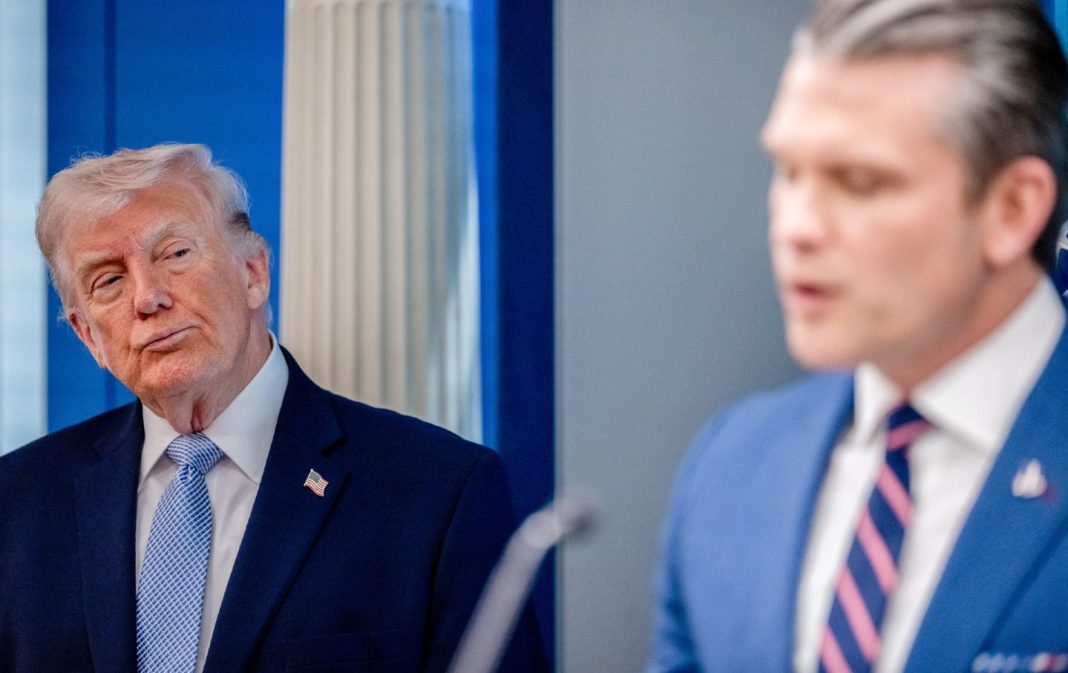
President Donald Trump, and Pete Hegseth, US secretary of defense, during a news conference in the White House on April 6, 2026.
(Daniel Heuer / Bloomberg via Getty Images)
Amid the liturgy of lies that Donald Trump hymns daily, he occasionally utters unvarnished truths that are unspeakable in polite company. He says the quiet part out loud. On presidential power: “I have an Article II, where I have the right to do whatever I want as president.” On the constraints on his use of military force: “There is one thing. My own morals. My own mind.… I don’t need international law.” On the racist predicate for his deportation horrors: “They are poisoning the blood of our country.” Or his $10 million lawsuit against the IRS: “I’m supposed to work out a deal with myself.” Or his admission about the aggressive war on Iran: “We don’t have to be there. We don’t need their oil. But we’re there to help our allies.”
And so on the eve of releasing a budget for next year that called for a staggering $1.5 trillion military budget—a $500 billion, 42 percent increase that would be the largest year-on-year percentage increase since the mobilization for Korean War, Trump admitted to the quiet part: “I said to [Office of Management and Budget director] Russell [Vought], ‘Don’t send any money for daycare because the United States can’t take care of daycare. That has to be up to a state. We can’t take care of daycare…. We’re fighting wars…. it’s not possible for us to take care of daycare. Medicaid, Medicare, all these individual things, they can do it on a state basis. You can’t do it on a federal. We have to take care of one thing, military protection.”
It wasn’t just daycare that would take the hit. The press reported that president’s budget called for a 10 percent cut in all non-defense discretionary programs (outside of Medicare and Medicaid, which were savaged last year, and Social Security), targeting primarily anything related to climate, the environment, civil rights, education, and food support and other poverty programs. But in reality, compared to the cost of continuing current levels of service, it slashes domestic programs by nearly one-fourth. With ICE and Homeland Security getting increases, targeted programs were cut to the bone: the Environmental Protection Agency cut by more than one-half, LIHEAP—heating subsidies for low income families—eliminated, another $20 billion lopped off rebuilding infrastructure.
The proposed $1.5 trillion annual military budget, about 5 percent of the GNP, is real money. As Dean Baker notes, it comes to about $12,000 per family. And that doesn’t include the $200 billion supplemental that the Pentagon will reportedly seek to pay for the war on Iran. The money lards a military-industrial complex that is the largest source of waste, fraud, and abuse in the federal government—and has never been able to pass an audit.
Not surprisingly, many Democrats and a few Republicans expressed consternation at the misplaced priorities. On the surcharge for the Iran War, Representative Ro Khanna summarized:
Let me tell you what $200 billion could do here in America. It would allow for free public college for every American kid. We could build a thousand trade schools, we could pay every American teacher $60,000 to start.
We could have universal childcare: childcare at $10 a day, with childcare workers making $25 an hour. And we could fully fund special needs education at 40% of what the federal government needs to fund.
Or it could pay to reverse the cuts already made in vital needs. Reversing the cuts in Obamacare made by Trump and the Republican Congress last year would cost $27 billion annually. Extension of the Earned Income Tax Credit that aided low-wage workers curing Covid would cost about $40 billion annually.
Current Issue

Trump repeatedly and correctly boasts that the US military is already the most powerful military in the world by far. The “Department of War” accounts for 40 percent of the world’s military spending, more than the next nine costliest militaries combined—seven of which are (or were before Trump) our allies. This despite the fact that, surrounded by oceans to the East and West and allies to the North and South, the United States is uniquely secure against any conventional assault.
Wars, of course, tend to “grease the runway” for military spending hikes. Whether a war as unpopular as the war of choice against Iran will do so remains to be seen. But Trump’s budget request isn’t really a wartime budget. Most of the increase is a down payment on military fantasies. A centerpiece is an initial investment in Trump’s Golden Dome, his utterly fantastical recycled version of Reagan’s Star Wars, calling for building a defensive “dome” against missile attacks. It will squander hundreds of billions on multiple layers of land-, sea-, and space-based sensors and interceptors designed to protect the US from next-generation missiles and drones. Like Reagan’s fantasy, the system won’t work, serving only to enrich high-tech military contractors, accelerate the arms race in space, and lead China and Russia and other future nuclear-armed adversaries (France?) to move toward hair-trigger alert postures. Add to that a down payment of $65.8 billion in shipbuilding for Trump’s “Golden Fleet,” featuring “Trump-class” battleships that, if our corrupted military contractors actually succeed in building, will provide tempting targets for inexpensive air and underwater drones that are becoming the weapons of choice for weaker countries.
Trump’s assertion that the federal government must focus on the military, and that our military, which is already the most powerful in the world needs a lot more money, is what lawyers would call an “admission against interest,” once more saying the quiet part out loud.
A $1.5 trillion annual military budget isn’t necessary for the defense of the United States. Rather it assumes that the US will continue to police the world. We will remain committed to global military hegemony—aiming to be dominant militarily in this hemisphere, from Europe to the Russian border, counter China in the South China Sea, strike terrorists across the world, sustain a global empire of 750-plus military bases, and deploy military forces to over 100 countries, while patrolling the seven seas.
That commitment condemns the US to constant wars in far corners of the world, as it has waged every year of this century. The “war of choice” against Iran is a classic example. According to Trump’s National Security Strategy released in November 2025, the Middle East is no longer a priority: “the days in which the Middle East dominated American foreign policy in both long-term planning and day-to-day execution are thankfully over—not because the Middle East no longer matters, but because it is no longer the constant irritant, and potential source of imminent catastrophe, that it once was.” Iran “has been greatly weakened,” progress toward “a more permanent peace” between Israelis and Palestinians “has been made.” As the US revs up energy production, “America’s historic reason for focusing on the Middle East will recede.” Less than four months later, Trump launched the war against Iran, allegedly because of the threat posed by nuclear weapons it does not have, and intercontinental missiles that it has not built.
The commitment to be the most powerful military power in every region of the world is both expensive and exhausting. The military is right when it argues that even this unprecedented military budget is inadequate to the task. We’ve been writing promissory notes to countries across the world—from Taiwan in the South China Sea to Ukraine to Israel and the emirates in the Middle East—largely on the assumption that they would never be cashed in.
Popular
“swipe left below to view more authors”Swipe →
It is this commitment and the wars that result that repeatedly sabotage efforts to ensure basic needs at home—as Roosevelt’s Economic Bill of Rights was lost to the Cold War, LBJ’s Great Society to Vietnam, Biden’s more modest domestic thrust to the cruel follies of Afghanistan, Ukraine, and Gaza.
As Trump’s admission reveals, we do guns. Guns are our core industrial policy, our major export, our budget priority, our foreign assistance program, and define our global presence. Trump, the self-declared “President of Peace,” wages a catastrophic war in the Middle East, drops bombs on seven countries and fishing boats in the Caribbean, kidnaps the president of Venezuela, vows to take Greenland, and seeks a 40 percent increase in the budget for his Department of War.
Hopefully, Trump’s ruinous rampages will lead Congress to rework his budget and alter his priorities. But nibbling at the edges will only revive the hypocrisy, not revise the reality. We will never begin to rebuild a broad middle class and provide minimal basic needs to Americans without a fundamental change of our role in the world. What Trump makes clear is that we can rebuild our country or ramp up our Department of War—we can’t and won’t do both.
More from The Nation
Dangerously wrong priorities will accelerate America’s decline.
Trump’s genocidal threat against Iran is one of the most vile and dangerous things an American president has ever done.
The so called SAVE America Act is nothing short of Jim Crow 2026.