


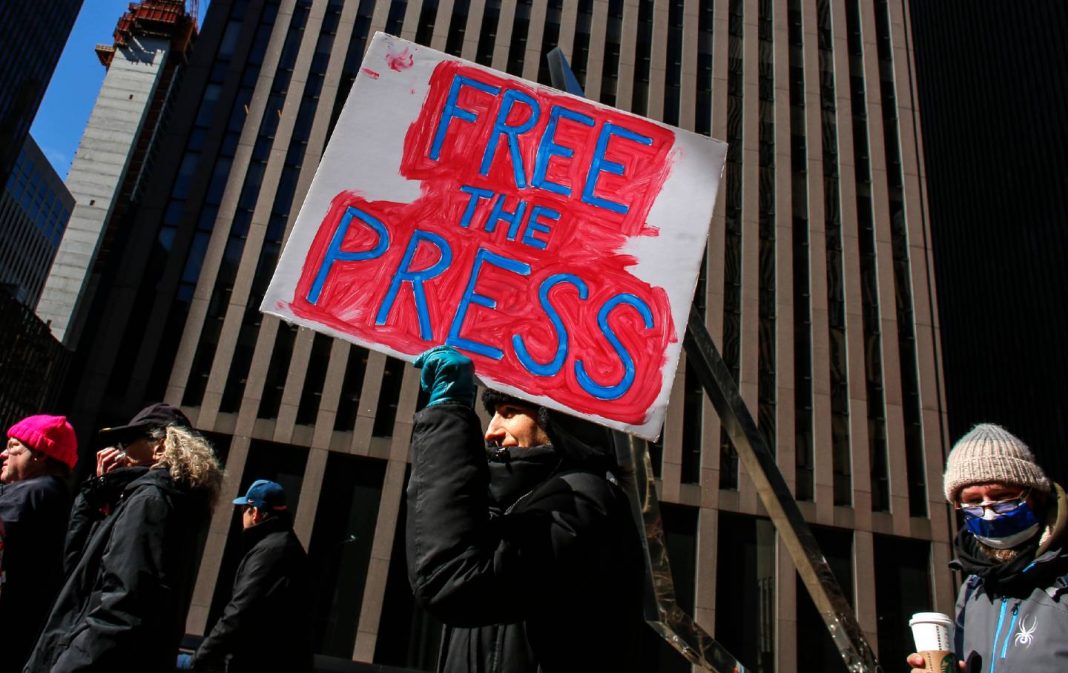

If he can’t stop the bad news from happening, the least an authoritarian can do is try to stop the dissemination of that bad news.
People take part in a protest outside the New York Times Building on February 26, 2017.
(Kena Betancur / AFP via Getty Images)
“It would be hard to describe the US as having a free press,” Jim Naureckas, longtime editor at the media-criticism organization Fairness and Accuracy in Reporting told me earlier this week. “The administration is openly calling for the punishment of media outlets based on the content of their coverage.” Even worse than the threats, he argued, was “the manipulation of regulations to concentrate media ownership in the hands of friends of the president. To have an openly authoritarian president picking and choosing which billionaires are going to have the stranglehold over information is a new level of censorship.”
Naureckas’s comments came after “Secretary of War” Pete Hegseth demanded that the media produce more “patriotic” stories about the Iran war and gushed about the likelihood that CNN would soon be taken over by the Trump-supporting Ellison family—which has been building up a vast MAGA-affiliated media empire with startling speed this past year. He also talked to me after FCC chair Brendan Carr warned broadcasters that they could lose their licenses for unflattering reports on the Middle East shit show. Following on Carr’s statement, Trump accused media companies of “treason” for their coverage of the war, the opening act of which included the United States bombing an elementary school and killing more than 175 children and teachers, and torpedoing a naval vessel, 2,000 miles from the conflict zone, that was returning from an international goodwill festival.
Trump’s war—which virtually all the United States’ allies, with the exception of Israel, have distanced themselves from—has drawn much of the Middle East into conflict. If it lasts much longer, it could spiral further, both militarily and economically. This week, Israel and Iran have begun direct attacks on energy infrastructure, setting natural gas fields ablaze and leading to enormous energy price spikes around the world. The war could easily now set off a global recession, and, with fuel prices soaring, it looks increasingly likely to fuel another round of inflation just years after the Covid-triggered inflation that has caused so much economic and political carnage since 2020.
As media outlets across the political spectrum have pointed out, this seems to be a war fought on the fly. Military strategy appears to emerge through middle-of-the-night social-media posts, not through consultations with regional specialists. You don’t have to believe me about this; listen to Joe Kent, who resigned as counterterrorism chief and said the war was launched with “no imminent threat” from Iran.
In a conflict in which the Iranians cannot hope to compete with US and Israeli hard power, it ought to have surprised no one that they would close the Strait of Hormuz in an attempt to trigger an international energy crisis. Except, somehow, it did surprise the US administration—which, it turns out, had DOGE’d their Middle Eastern energy experts in the run-up to the war, leaving grand strategy in the hands of know-nothings and bombs-away blowhards such as Jared Kushner, Steve Witkoff, Trump, and Hegseth. With clowns in charge, the result has been a circus.
Current Issue

To be clear, blaming the media for the lack of any coherent strategy to pursue the war and to plan for the aftermath is akin to shooting the messenger. It’s also quintessential authoritarian-playbook behavior. If you can’t stop the bad news, at least you can attempt to stop the dissemination of that bad news. And if you can’t stop the dissemination of bad news, well, you can always accuse the messengers of treason.
“Under the First Amendment, the press decides how it wants to report the war. The government cannot control what the press says,” explained Erwin Chemerinsky, the dean of the UC Berkeley School of Law. Yet that is precisely what the Trump people are attempting to do.
Chemerinsky told me there is ample Supreme Court precedent, based on a 1963 anti-censorship case, Bantam Books v. Sullivan, and the more recent NRA v. Vullo ruling, that a government official or agency’s threatening consequences against an institution that exercises its First Amendment free speech rights is unconstitutional. Carr must know that. Even if neither neanderthal Hegseth nor a sundowning Trump have a particularly firm grasp on constitutional law, their legal advisers are surely aware of these landmark cases. Yet the firehose of intimidation tactics against the media continues. “It’s an attempt to intimidate the press, as was Carr’s statement, ‘We can do it the easy way or the hard way’ against Jimmy Kimmel,” as was the administration’s demands that broadcasters remove late-night hosts who made critical statements about Charlie Kirk after his killing, the law school dean said.
Chemerinsky’s fear, he continued, is that the worse the war goes, “the more it [the administration] might escalate pressure on the media.”
Jelani Cobb, the dean of Columbia University’s Graduate School of Journalism, agreed: “I think it’s pretty standard; even in democratic governments, there’s a tendency to use times of war as a power grab, to suppress dissent and criticism of the war. With authoritarians, it’s particularly important. For Brendan Carr, it’s part of a bigger pattern. It’s exactly what the First Amendment was meant to prevent.”
Cobb said that Trump 2.0 has played fast and loose with constitutional niceties: “This administration has taken from the outset an à la carte approach to the Constitution.” The administration, he said, has banked on media owners, white-shoe law firms, and others to duck and cover rather than stand their ground against a vengeful government.
If the administration succeeds in intimidating large media outlets to bend their coverage of the Iran War, Cobb said he fears that they will take that as a license to then demand changes in how broadcasters and newspapers cover the midterm elections; and, to curry favor, major publishers and owners just might comply. “I’m very worried about this,” Cobb told me. “History bears out we shouldn’t be shocked if this happens.”
The well-respected V-Dem (Varieties of Democracy) index (from the eponymous institute headquartered at the University of Gothenburg) agrees. This week, the publication downgraded the political status of the United States, asserting that it no longer qualifies as a liberal democracy and that, fueled by the assault on the media, freedom of expression is at its lowest point in the country since the end of World War II. Free speech rights, the authors note, are often “the first ‘domino’ to fall when countries autocratize.”
Even before February 28, the reasons for Donald Trump’s imploding approval rating were abundantly clear: untrammeled corruption and personal enrichment to the tune of billions of dollars during an affordability crisis, a foreign policy guided only by his own derelict sense of morality, and the deployment of a murderous campaign of occupation, detention, and deportation on American streets.
Now an undeclared, unauthorized, unpopular, and unconstitutional war of aggression against Iran has spread like wildfire through the region and into Europe. A new “forever war”—with an ever-increasing likelihood of American troops on the ground—may very well be upon us.
As we’ve seen over and over, this administration uses lies, misdirection, and attempts to flood the zone to justify its abuses of power at home and abroad. Just as Trump, Marco Rubio, and Pete Hegseth offer erratic and contradictory rationales for the attacks on Iran, the administration is also spreading the lie that the upcoming midterm elections are under threat from noncitizens on voter rolls. When these lies go unchecked, they become the basis for further authoritarian encroachment and war.
In these dark times, independent journalism is uniquely able to uncover the falsehoods that threaten our republic—and civilians around the world—and shine a bright light on the truth.
The Nation’s experienced team of writers, editors, and fact-checkers understands the scale of what we’re up against and the urgency with which we have to act. That’s why we’re publishing critical reporting and analysis of the war on Iran, ICE violence at home, new forms of voter suppression emerging in the courts, and much more.
But this journalism is possible only with your support.
This March, The Nation needs to raise $50,000 to ensure that we have the resources for reporting and analysis that sets the record straight and empowers people of conscience to organize. Will you donate today?