


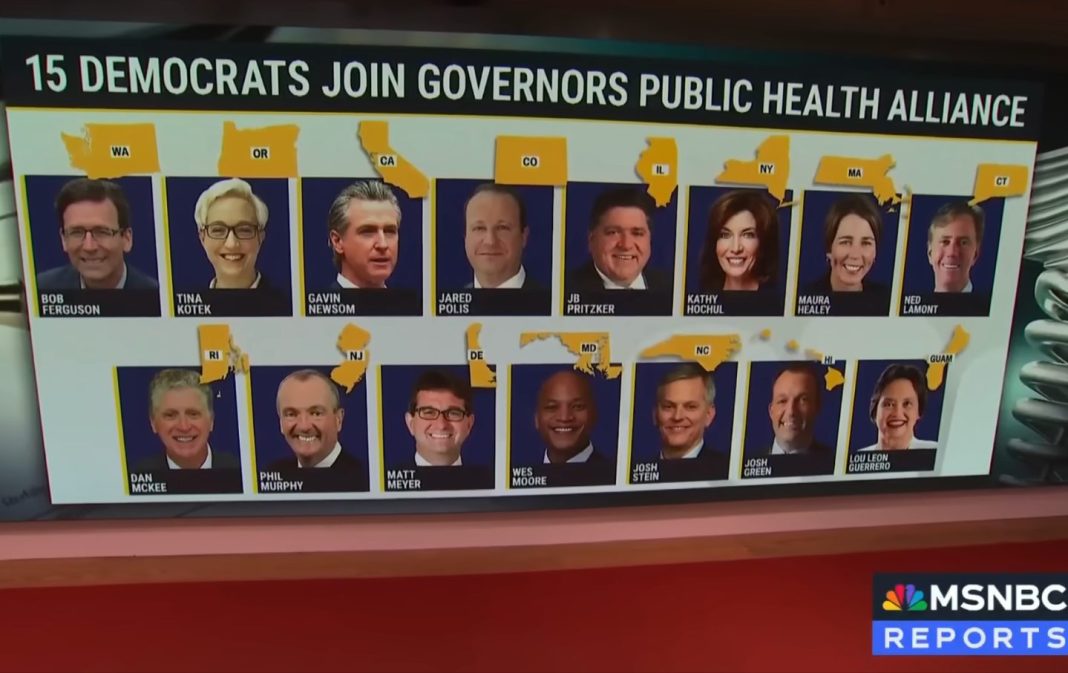

Whether or not you have access to independent, scientifically sound public health guidance may depend on how your state voted for governor.
Last October, 15 Democratic governors announced the creation of a Governors’ Public Health Alliance—a plan to share resources, coordinate public health guidance and disease surveillance, and exchange information across state lines. The announcement followed the creation of two other public health state alliances—the West Coast Health Alliance (which links California, Oregon, and Washington) and the Northeast Health Collaborative (which links 10 states with Democratic governors in the Northeastern United States). In light of the systemic dismantling of America’s public health agencies, these moves essentially create a shadow infrastructure to maintain some of what is being lost. While this is a promising development, it does nothing to stop a troubling trend that has been emerging for some time: The country is quickly becoming fragmented along partisan lines when it comes to public health, and whether or not you have access to independent, scientifically sound public health guidance may depend on how your state voted for governor.
The responsibility for public health in the United States is normally shared by a patchwork of different agencies at all levels of government. The federal government broadly coordinates disease surveillance for the nation, funds public health programs and scientific research, and provides guidance that local health departments and doctors rely on. The federal government also gets involved when disease transmission is an international or interstate affair. Local health departments, meanwhile, are the boots on the ground, conducting testing (of disease, contaminants like lead, bacteria in lakes, etc.), coordinating immunization programs, taking care of local outbreaks, and providing supplies (like clean syringes to prevent infectious disease spread). Think of the federal government as the engine that powers the machine and the local authorities as the gears that make it run.
As we all know from the Covid years, local and state governments also typically hold the authority to compel people to do things that are in the best interest of the public’s health, like quarantines, vaccination requirements, mandates on capacity, testing, and masking. The federal branch holds little power in this regard, with the exception of interstate and international travel. During the pandemic, for instance, the federal government was able to implement a mask mandate only on transportation and in government buildings.
But these are not normal times, and the usual relationships between governments are breaking down. A useful example to think through is vaccines. The Centers for Disease Control and Prevention (CDC) is supposed to set recommendations for a vaccine schedule through its Advisory Committee on Immunization Practices (ACIP), while the Food and Drug Administration (FDA) approves the vaccines for use in certain populations. State governments then broadly follow the vaccine schedule when deciding what vaccines to make mandatory for schooling. Yet, since Donald Trump returned to power and installed Robert F. Kennedy Jr. as Health and Human Services Secretary, many of the advisers on ACIP have been pushed out and replaced with anti-vaccine advocates, and the CDC staff who support the committee have been fired. The RFK-ified FDA recommended that the Covid vaccine be made available only to those 65 and older and those who are over 6 months and have a high-risk condition. In response, a number of states (all with Democratic governors, save for Virginia) took action to ensure that Covid vaccines would be available to people without a prescription.
It’s not just blue states diverging from Washington; some red states are going their own way too—though in the opposite direction. For instance, the Florida Department of Health announced in September that it was getting rid of all vaccine requirements for schooling—the only state in the nation to do so. (Days later, the state backtracked; however, it has not abandoned the plan). And 400 anti–public health bills have been filed in statehouses across the country, according to an analysis by the Associated Press. These bills deal with everything from vaccines to fluoride to milk safety. Idaho’s Medical Freedom Act, which was passed in April, banned state and local governments from having vaccine requirements. It’s now being heralded as a piece of model legislation for the anti-vaccine movement. Most states have some sort of exemption process for vaccine requirements, but these exemptions are becoming easier to get. According to the Kaiser Family Foundation, 10 states (all with Republican governors) have made moves this year to make getting an exemption easier. All of this has taken its toll since the Covid-19 pandemic, as vaccination rates have dropped for kindergarteners in the US.
Health disparities already exist along partisan lines. Some of the lowest life-expectancy rates in the United States can be found in Appalachia and the South, while the highest life expectancy can be found in West Coast states. Researchers have also found that Republican-leaning counties (even when adjusted for age and urban/rural natures) have lower life expectancy than Democratic-leaning counties. During the Covid-19 pandemic, vaccination rates were higher in blue counties than red counties. When it comes to Medicaid expansion, only 10 states have yet to expand Medicaid—nine of them have Republican governors.
Current Issue

As the federal government makes dramatic changes, some states will choose to fight in the courts and take other measures to preserve their state’s public health, while others will not and will suffer for it. For instance, 80 percent of terminated CDC grants to local health departments were restored in blue states, compared to 5 percent in red states, according to a KFF analysis. In the midst of this landscape, anti–public health actors are taking advantage and trying to advance bills that serve their agenda. It would be tempting for some to say that the people in the red states are getting what they deserve—but not only is this contemptuous of the people who live there (the vast majority who still get vaccinated); it also ignores the nature of disease transmission.
During the West Texas measles outbreak, measles traced to that outbreak ultimately spread to New Mexico, Kansas, and Oklahoma. There are currently active outbreaks of measles in Utah, Arizona, and South Carolina; this is a problem that the entire United States will have to deal with. What happens in one state can’t be isolated from the others.
Those of us in public health need to recognize the terrain that we are on. Opponents of sound public health measures are mobilizing across all 50 states; we need to do the same. So far, there has been a lot of attention on health communication and behavioral strategies—how we can get people to choose to be vaccinated and tackle misinformation. But we need to start training people in what I call health mobilization. This means we approach vaccination and other public health problems as political issues and work to organize to get public health legislation passed—or to make sure terrible laws don’t get passed. For instance: vaccine exemption laws can always be strengthened to make the bar to get an exemption higher. There are states with Democratic governors facing significant challenges with vaccinations—Minnesota, Wisconsin, and Colorado all have vaccination rates for the MMR vaccine in the 80s (86–88 percent) for kindergarteners, a 6 percent drop for each state since 2019. The target set by the federal government is 95 percent.
There are also several states with Democratic governors and Republican-controlled state legislatures, like Kentucky, Kansas and Arizona. These purple-state governors should join the health alliances set up by their blue state counterparts. The alliances should also publicly extend invitations to Republican led states, even if they are unlikely to join.
Since a significant amount of funding for public health departments comes from the federal government (and this may be slashed, in addition to cuts that have happened), states need to start proactively planning now to fill gaps to ensure critical infrastructure remains, including through new wealth taxes. Similar approaches should also be looked at for Medicaid cuts, which will be devastating for rural hospitals in particular. The federal government created the $50 billion Rural Health Transformation Program to offset some of these impacts. However, as analysts point out, such “offsets” may be misleading as Medicaid cuts aren’t set to take effect immediately but their impacts could last longer than this health fund, which is set to expire in 2030.
And all of this needs to be married to a broader movement on healthcare. People are frustrated with the cost of healthcare, are afraid of losing it, and are drowning in medical debt. There’s a reason Josh Hawley and Marjorie Taylor Greene were talking about Medicaid and ACA cuts. While anti–public health voices push legislation under the guise of freedom, public health voices need to talk about how people can’t afford to be healthy, are drowning in costly medical bills and spending time arguing on the phone with insurance companies. One measles infection can represent a lifetime of debt. While states may not be able to pursue Medicare for All, they can pursue public option plans; they can also use funds to cancel medical debt like some states did with money from the American Rescue Plan. These things may seem more difficult in a climate of austerity, but it is this type of imaginative vision that will be required to go to toe to toe with anti–public health movements. We can’t just defend the terrain; we need to expand the horizon.
It is likely that outbreaks of vaccine-preventable disease will continue, that we will see a steady decline in our public health infrastructure, and that disparities between red and blue areas will increase. Public officials need to defend and maintain what they can and set the stage for a recovery when that is feasible. We cannot only hope for a new progressive era where public health is strengthened, as bleak as things seem—we can work toward it.
More from The Nation
Industry partnerships in higher education are pushing STEM graduates into the business of weapons manufacturing and genocide profiteering.

After putting on their very best performances of solidarity every Black History Month, this year corporate marketers have seemed at a loss for words.
We are seeing yet another example of state-sanctioned violence against the reproductive futures of those deemed outside the national body.

The Brazilian star Vinicius Jr. has repeatedly been a victim of racist abuse from soccer fans. Now, it seems such vitriol can even come from players without much consequence.

The real Olympic heroes were the athletes who stood up for each other—and against Trump.