



In November, the governor issued a proclamation declaring CAIR, the country’s largest Muslim civil rights and advocacy group, a terrorist organization. “It’s about sowing suspicion.”
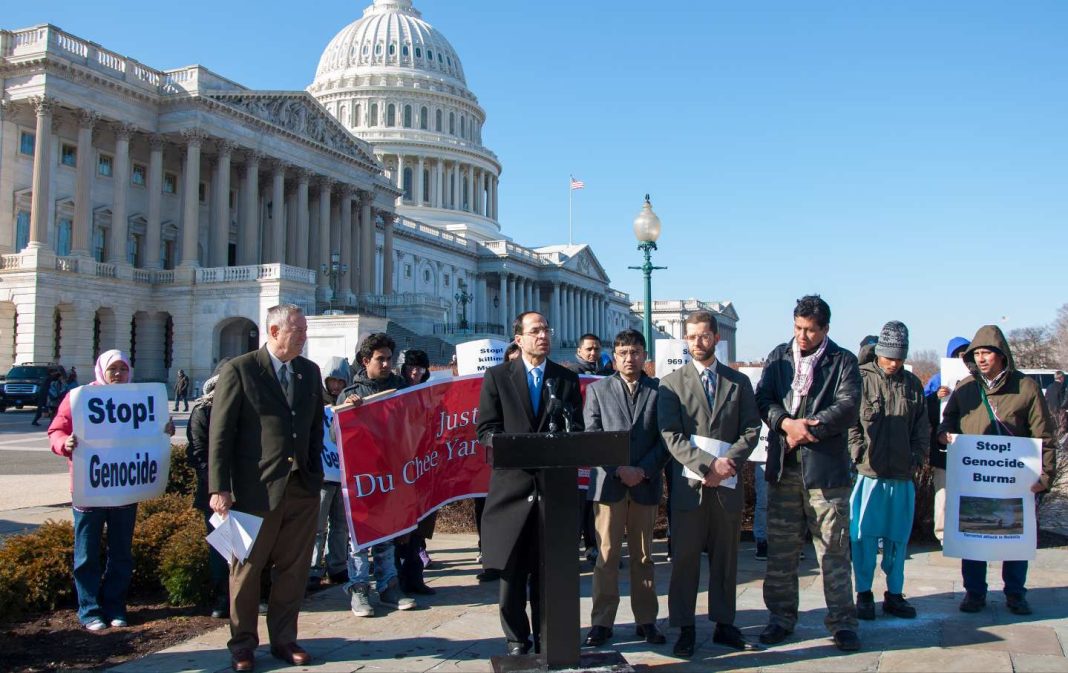
A press conference held by the Council on American–Islamic Relations.
(Omar Alsaray / CAIR)
The Council on American–Islamic Relations (CAIR) is the largest and most prominent Muslim civil liberties organization in the United States, founded in 1994 to provide legal support, monitor hate crimes, promote government relations with the Muslim community, and mobilize Muslim voters. For the last few years, it has also been deeply involved in student organizing and pro-Palestinian activism following Israel’s assault on Gaza.
When CAIR’s national executive director Nihad Awad made comments in the days immediately following the October 7 attacks saying that he was “happy to see people breaking the siege” of Gaza and arguing that “the people of Gaza have the right to self-defense,” the Biden administration publicly disavowed the group. In August, Senator Marco Rubio was asked in a telephone interview about the possibility of identifying CAIR as a terrorist organization alongside other groups like the Muslim Brotherhood.
Since then, criticism of CAIR, especially among Republicans in Texas, has only intensified. On November 18, Governor Greg Abbott issued a proclamation declaring CAIR a “terrorist organization.” The order branded the group as a “front” for Hamas and, among other sweeping restrictions, barred the organization from purchasing land in the state.
Following Abbott’s declaration, the acting state comptroller has attempted to block certain private schools from participating in the state’s voucher program over their association with CAIR. In December, Florida Governor Ron DeSantis issued a similar declaration in his own state. That same month, Abbott sent a letter to Treasury Secretary Scott Bessent asking that he revoke CAIR’s tax-exempt nonprofit status. The Department of the Treasury has not responded to Abbott’s request, though Abbott has similarly directed Texas Attorney General Ken Paxton to launch an investigation against CAIR to possibly remove its nonprofit status, which has culminated in Paxton filing a lawsuit against CAIR earlier this month to ban its operations within Texas.
Governor Abbott’s proclamation represents a dramatic escalation of a much larger trend of Islamophobia within Texas politics. Early last year, Abbott and other prominent Texas Republicans waged a public battle against the East Plano Islamic Center over its proposed expansion—dubbed “EPIC City,” which would include residential housing, a faith-based school, and community facilities. A lightning rod for conspiracy theories and anti-Muslim rhetoric across the state, the project was repeatedly mischaracterized and targeted with intense scrutiny by prominent Texas Republicans like Abbott as an attempt to establish a “Sharia city.” State investigations and legal challenges over land use and governance soon followed.
For CAIR’s leadership, the performative proclamation holds real implications for Muslims in the state. Edward Ahmed Mitchell, CAIR’s national deputy director, said the group had received no prior formal communication about the designation. “That shows you again, it’s a publicity stunt. They didn’t demand any information from us. They didn’t send us any notice,” Mitchell said. “They just went to the press, because it’s really about whipping up their base, whipping up anti-Muslim hysteria.”
Current Issue

Since 2023, CAIR has handled roughly 8,000 civil-rights complaints per year—the highest on record—many tied to pro-Palestinian advocacy. Muslim families across Texas report growing fear of harassment, surveillance, and retaliation for exercising their First Amendment rights. “They don’t want Muslims to be involved in politics at all,” said Mustafaa Carroll, the executive director of CAIR’s Dallas-Fort Worth chapter. “And that’s why we encourage Muslims to participate. This is the most American thing you can do.”
CAIR’s work, he emphasized, is indistinguishable from that of other civil rights organizations: protecting constitutional rights, building interfaith coalitions, educating the public, and supporting community members facing discrimination. “There’s nothing we’re doing that’s outside the scope of what other civil rights groups are doing,” he said.
State Representative Salman Bhojani, one of the first Muslim lawmakers elected to the Texas Legislature in 2022, described a broader strategy to marginalize Muslim civic life. “What’s unfortunate is that CAIR is a civil rights organization for the Muslim community,” he said. “I’ve seen firsthand how they’ve helped Muslims who were targeted.” He recalled a recent anti-Muslim hate crime in his own district where CAIR assisted the victims with the legal process. “Maybe the goal here is to dismantle those foundational organizations so Muslims don’t have a voice in America.”
In response to Abbott’s proclamation, CAIR filed a lawsuit in federal court claiming his move is unconstitutional on multiple grounds, from First Amendment rights to due process, and that it exceeds the power of a governor. Mitchell emphatically denied the accusations of ties to terrorist groups laid out in Abbott’s proclamation. The CAIR website now has a “Dispelling Rumors” page that fact-checks many of these claims.
“We have condemned terrorism so often that ISIS threatened to assassinate our leader. We’ve spoken out against the Israeli government’s genocide and war crimes, but we’ve also been morally consistent. We’ve spoken out against Hamas attacks on Israeli citizens, including attacks on civilians on October 7,” said Mitchell. “So unlike Ron DeSantis and Greg Abbott, who supported the Gaza genocide, CAIR has been morally consistent.”
Mitchell pointed to CAIR’s litigation history with Abbott’s office, noting that the organization has successfully sued the governor three times in recent years over policies restricting pro-Palestinian advocacy and speech. “What Ron DeSantis of Florida and Greg Abbott of Texas did does not surprise us at all. These are both Israel-first politicians, anti-Muslim bigots, who have spent years trying to silence Americans critical of the Israeli government, especially American Muslims. So when they tried to attack CAIR, it’s no surprise,” Mitchell said.
The move comes at an especially charged moment for the Muslim community, Mitchell noted, pointing to a “sharp and obvious rise” in anti-Muslim rhetoric and policies which he says are connected to the increasing civic and political engagement of American Muslims. “They’re lashing out, trying to smear and silence American Muslims because of our support for Palestinian human rights. And they can’t win the argument, they can’t convince the American people that it’s good to fund a genocide,” said Mitchell.
Mitchell emphasized that this backlash is not limited to Texas and Florida, but reflects a national effort to manufacture fear around Muslim political participation. “So instead what they want to do is scare the American people with a Muslim boogeyman.”
“Get the American people to fear EPIC’s community-led development, the Somali Americans in Minnesota, CAIR in Texas, CAIR in Florida, Zohran Mamdani in New York. Somehow this very liberal Democratic Socialist is going to impose Sharia law in New York. All this is nonsense, but the whole point is to whip up anti-Muslim hysteria.”
“We are always anticipating attacks,” said Carroll. For decades, he noted, Texas Republicans have revived Islamophobic legislation as a mobilizing tool. He pointed to the first anti-Sharia bill he encountered in the state legislature, introduced in 2011 by former state representative Leo Berman. Since then, versions of such legislation have resurfaced every few years. “The community has been under severe scrutiny ever since 9/11. It ebbs and flows with whatever’s happening in the world—and right now, it’s Palestine and Gaza.”
But CAIR’s leadership has remained defiant. “We are still open for business, we are doing the work the community expects us to do, even amid the challenges, threats, and difficulties that these orders create,” Mitchell said. He described a “loud outcry” across Texas from civic leaders, faith groups, elected officials, and community organizations condemning Abbott’s actions as both unlawful and bigoted.
But the stakes, he warned, extend far beyond CAIR. If left unchallenged, the executive actions taken by Abbott and DeSantis could establish a dangerous precedent, expanding gubernatorial authority in ways that could threaten any advocacy group. “It’s important, not just for CAIR Texas and CAIR Florida, but for the sake of every American’s right to organize, that their efforts be defeated.”
A broad coalition has mobilized to rally behind CAIR, including interfaith and religious groups, local officials across the state, advocacy groups like the ACLU of Texas and the Texas Freedom Network, the Texas Democratic Party, members of Congress—including Representatives Ilhan Omar and Rashida Tlaib—and a group of Texas legislators led by Bhojani.
Popular
“swipe left below to view more authors”Swipe →
Shortly after the proclamation, Bhojani and other Democratic lawmakers sent a formal letter warning that Abbott’s proclamation threatens constitutional rights and public safety. “I want to make sure we don’t have any terrorist activity in our state. I’m as invested in this country as anyone else,” he said. “But this isn’t about that. It’s about sowing suspicion.”
Reactions inside the legislature have fallen largely along party lines, according to Bhojani, pointing to repeated attacks by Republican officials, including former Tarrant County GOP chairman Bo French, who used inflammatory rhetoric about Muslims, CAIR, and Bhojani himself. “It’s really ironic,” he said, “that while we’re restricting the freedoms of Muslims in this state, we said the Ten Commandments should be displayed in all public schools, that students should have the right to pray and study the Bible in school.”
Ibrahim Islam, a senior at the University of Houston who has organized with CAIR in the weeks since Abbott’s proclamation, said there have been some debates among student groups about whether they can associate with CAIR in order to prevent students from being targeted. But the dominant response has been defiance and solidarity, with people “defending and huddling up around CAIR.”
“The general sentiment is that we need to stand strong with CAIR because CAIR has stood strong and defended us constantly,” Islam said. “There’s a memory of the work CAIR has done, and a trust because CAIR has stuck its neck out in the most vulnerable moments. For me, I remember that to be the encampment. There was a CAIR person standing right there for us to make sure nothing went wrong.”
For Bhojani, the path forward lies not in retreat but in deeper civic engagement. “Even when it feels like the least logical thing to do,” he said, “we need more participation now, not less. The power belongs to the people of Texas.”
As CAIR’s lawsuit against Texas plays out in federal court, both Mitchell and Carroll reaffirmed that the organization was still committed to serving its mission of defending the Muslim community, which will rise to meet this moment. “Nothing has changed in terms of what we do,” Carroll said. Ultimately, Mitchell applauded the “resilience and defiance” from the Muslim community, and reaffirmed CAIR’s commitment to its mission. “We are a shield,” he said. “And a shield is supposed to take arrows.”
More from The Nation
But Tom Homan is a lying liar, and the work’s not done. Plus, Gallup’s sketchy new polling policy (is the analytics firm in the Trump tank?), the law for deepfakes, and more in th…
Even conservatives are fleeing the GOP as more and more Americans turn against Trump’s authoritarian project.
The administration’s sketchily funded Freedom 250 project, which will oversee the celebration of America’s semiquincentennial, is a pageant of right-wing extremism.