



The mayor mobilized New York’s resources nimbly and creatively. Now, on to the budget
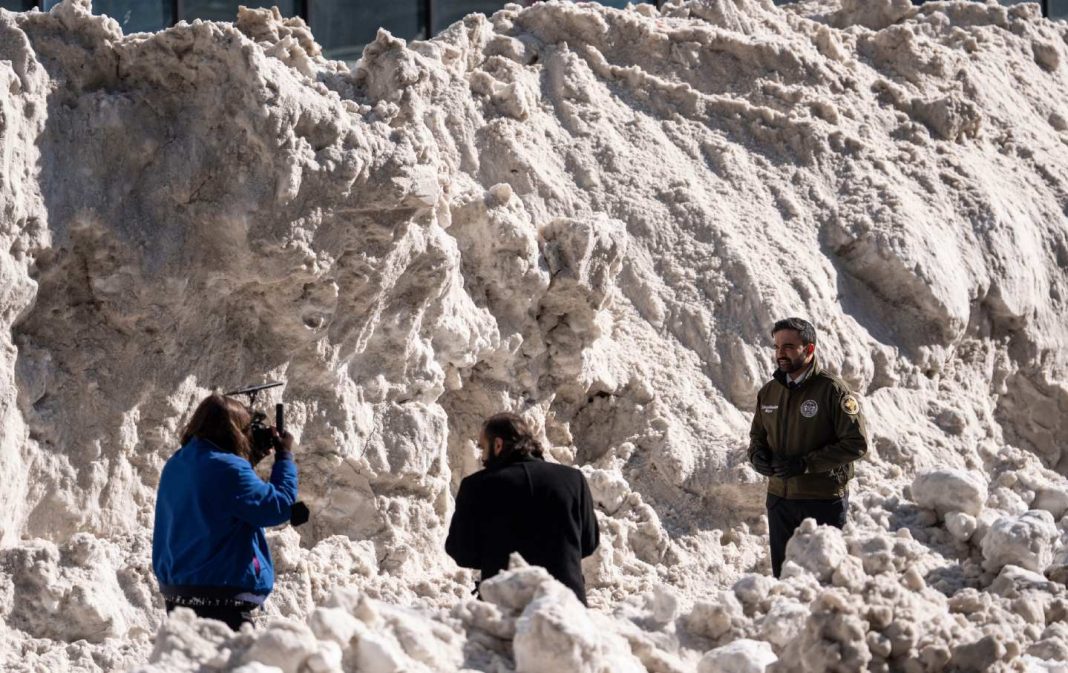
New York Mayor Zohran Mamdani records a video alongside a snowbank.
(Yuki Iwamura / AP Photo)
Who says there are no do-overs in politics?
Less than a month after a historic snowstorm and cold spell first tested Zohran Mamdani’s administrative mettle, last weekend’s blizzard offered a second chance for New York’s 34-year-old mayor to demonstrate his ability to manage a weather crisis—a challenge that several of his predecessors have failed to meet. It also provided an encouraging indication of his dedication to learning on the job.
As faithful readers will recall, this observer gave the mayor an A- for his first encounter with Big Snow. The streets were cleared quickly and efficiently, but bus stops and crosswalks remained perilous for days. And as the death toll from the cold mounted, claims of an “all-of government” approach to the crisis began to ring hollow.
It’s true, as the mayor noted, that previous snowstorms have been followed in a few days by weather warm enough to melt the ice cliffs left in the wake of Department of Sanitation snowplows. And, so far at least, deaths from cold in the city aren’t out of line with historic levels. But they were still shockingly high for an administration whose top lawyer, Steven Banks, was (according to The New York Times) “the most successful social-services director in New York City history.” And when it emerged that seven people had died from hypothermia inside their own homes, the consequences of a failure to properly coordinate the city’s response became more evident.
As one veteran city official reminded me, the city’s Department of Housing Preservation and Development maintains a data base of heat complaints. That should have made it easy to pinpoint repeat-offender landlords and buildings. Other city agencies are supposed to keep track of homebound New Yorkers, whether from illness, disability or old age, who are in need of assistance. That so many New Yorkers fell through the city’s safety net was a clear sign that changes were needed. Fortunately, someone at City Hall was paying attention.
Earlier this week, the city’s helpful online snow-plow tracker again made for encouraging reading. And this time the administration stirred much more quickly out of the laggard posture that needlessly jeopardized lives in the last storm. Mamdani officials were determined to bring people in out of the cold—even when they preferred to remain on the streets. The city also bumped the pay for temporary snow shovelers—the workers who clear crosswalks, bus stops, and the sidewalks beside city-owned property—to $30 an hour, which helped to quickly double the number signed on during last month’s snowstorm. And it appears that warmer weather this coming weekend may finally reduce New York’s snow-and-dogshit mountains to the mere messy molehills city residents are long accustomed to navigating around.
Current Issue

Although the remark is often attributed to Napoleon, it was an earlier French politician, Cardinal Mazarin, who, upon hearing one of his generals praised for his competence, replied “But is he lucky?” This week’s snowstorm sequel, along with his astonishingly successful come-from-behind campaign in last year’s Democratic primary, suggests that in Mamdani’s case the answer is yes.
But even if his luck holds, the mayor is going to have to keep learning on the job—which will probably mean widening the circle of those he consults. His apparent reluctance to do so is perfectly understandable, given the avalanche of money mobilized against him during the fall’s general election campaign. Although the anyone-but-Zohran initiative turned out to be a colossal waste—according to The City, the final tab worked out to roughly $65 a vote—New York’s wealthiest still have plenty of money to burn. There was a brief period, as Mamdani’s victory became more and more likely, when some portion of the city’s permanent government arrived at a grudging acceptance of the democratic socialist. But that uneasy peace—largely brokered through the efforts of Kathryn Wylde, who at the time headed the pro-business Partnership for New York City (and for the record, a woman I’ve never met)—appears to be breaking down even faster than the ice on the Central Park reservoir.
Wylde has retired, and the incorrigible offenders among New York’s Epstein class are already busily conspiring to bring the mayor down—or at least keep him in line. Their ranks include longtime Cuomo lieutenant Steven Cohen, tech-investor/political operator Bradley Tusk, and political consultant Phil Singer, whose firm worked for Cuomo’s Fix the City super PAC. Scott Stringer, who finished a dismal fifth in last year’s Democratic primary, seems to be auditioning to be the front man for this effort—a sad comedown for a once promising politician who racked up a creditable record as a genuinely progressive city comptroller.
Still, the emergence of such opposition should come as no surprise. Mamdani’s entire campaign posed a genuine threat to the city’s entrenched plutocracy—especially the overweening finance and real estate interests who have long grown accustomed to calling the shots in both the city and state. For Mamdani to deliver on the three principal promises of his campaign—freezing rents for rent-stabilized tenants, offering free childcare to all New Yorkers, and making the city’s buses both “fast and free”—will require confronting those entrenched interests again and again. That goes double for Mamdani’s lofty pledge in his inauguration speech to “govern as a democratic socialist.”
Mamdani has already shown a repeated ability to out-organize his opposition on the streets. Judging by the turnout for Our Time’s Albany Takeover on Wednesday—at 1,500, more than a battalion, but considerably less than a division—neither the mayor, who skipped the proceedings, nor his troops, are fully engaged in this fight. But then taxing the rich to plug a budget hole isn’t exactly the most inspiring rallying cry. Better messaging might help. And in the meantime, the mayor might also do more to bolster his forces—especially as the battle over the city’s proposed budget heats up. Someone should be energetically making the case right now that having the city provide free childcare and free buses would be good for every business whose workers and customers rely on those services. Mamdani might also reach out to politically sympatico former insiders—Kathryn Garcia, currently running the Port Authority after a long record of hyper-competence in city government, comes to mind—to meet with a select group of current commissioners and agency heads to help them identify actual savings in their departments. That would help give the administration the fiscal credibility its current budget theatrics lack. Brad Lander, a crucial ally whose own congressional campaign is currently paralyzed over uncertainty about district boundaries, could also be a huge help here.
But having donated ($50) to his campaign, and after the great pleasure of voting for him in both the primary and general elections, I certainly want the new mayor to succeed. More than that, I want Zohran Kwame Mandami to join Fiorello La Guardia and Franklin Delano Roosevelt in the tiny pantheon of New York politicians who genuinely enlarged not only New York’s public sphere but our vision of what is politically possible. Delivering on his three signature policies alone would make Mamdani a transformative mayor. But since, unlike some of his predecessors, he can’t waste time fantasizing about running for president since he’s foreign-born, my hopes for him and his administration run higher than that. LaGuardia and FDR lifted New Yorkers’ imaginations of what city life, and the common good, could include in the middle of the Great Depression. New York today is the wealthiest city, as a famous Brooklyn native frequently observes, in “the wealthiest country in the history of the world.” Free buses are just the beginning of what we should hope for.
Finally a personal note. Some friends have complained that my recent columns have been too hard on the new mayor. It’s certainly true that on November 9, 2016, I adopted “no more wishful thinking” as a professional mantra. Besides, a vigorous skepticism should be part of any reporter’s toolkit; as they used to drill into the young recruits at Chicago’s City News Bureau, “if your mother says she loves you, check it out.”
Popular
“swipe left below to view more authors”Swipe →
However, I’ve also seen what happens when high hopes are replaced by disillusion and despair—not just in New York, or the United States, but in Greece, or France, or Britain. When socialists fail, too often reaction and repression come in their wake. To keep that from happening here, Mamdani will need to show the same creativity in government that he displayed on the campaign trail, and to actually deliver on the vision of excellence and transparency he has repeatedly promised in office. Snowstorms pose a small test; getting a final budget that is credible and reflects his priorities will be much, much harder. It will require a lot more than good luck. Still, a little good luck never hurts.
More from The Nation
Administration officials and their collaborators must know that if they break the law they will be punished. There must not be impunity for those attacking our democracy.
How winning people’s trust involves listening to their challenges, ambition, ideas, and stories.
An increasingly unpopular Trump lurched from plodding teleprompter readings to gothic MAGA fantasies in his long-winded speech.
The progressive representative from Pennsylvania will speak truth to Trump’s power tonight.