



By failing to absorb the lessons of Iran’s strategic victories, the White House is on course to turn the present stalemate into a disastrous quagmire.
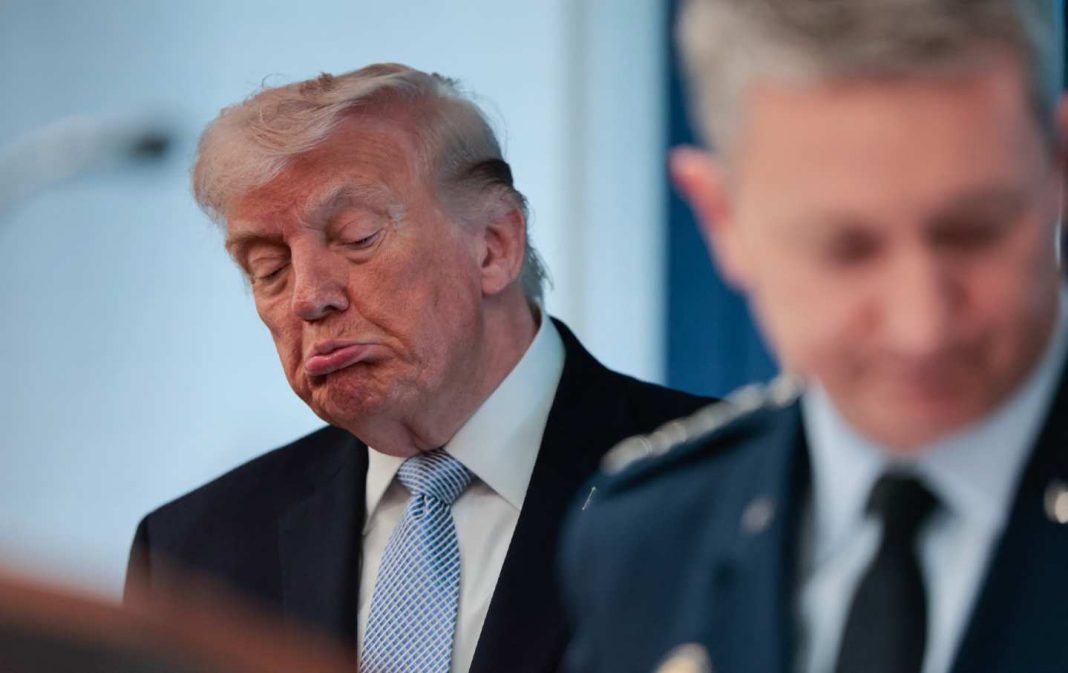
President Donald Trump stands alongside Chairman of the Joint Chiefs of Staff Dan Caine at an April press conference on the Iran war.
(Kent Nishimura / AFP via Getty Images)
The conventional wisdom today is that President Donald Trump can’t bring himself to sign off on specific aspects of an interim agreement with Iran that finally reopens the strategic Strait of Hormuz to commercial shipping because cutting a deal would deeply wound his delicate pride. By this reckoning, the president is just too arrogant and delusional to countenance an agreement that looks anything like the President Obama’s Joint Comprehensive Plan of Action that he scuttled in 2018 and has railed against for years as an embarrassing capitulation.
This general assessment of Trump’s haphazard approach to an accord to end hostilities with Iran isn’t wrong, but it tends to downplay how deeply unworkable the president’s preferred exit strategy really is. Today, any return to the status quo ante in Iran—a basic framework to contain the country’s nuclear ambitions in exchange for standard economic and diplomatic concessions—isn’t really achievable. What’s more likely, amid the stalemated US offensive and shambolic overtures to broker subsidiary regional agreements to rein in Iran, is a moderately less favorable deal than the one Trump torched eight years ago, because America’s strategic position in the region is clearly in irreparable shambles.
The US and Israeli militaries have failed to produce the results they hoped for in their Plan A approach to bring the Iranian regime to heel with a massive display of air power. And the weeks-long standoff over control of the Strait of Hormuz has made it painfully clear that Tehran now possesses its own considerable leverage over the global economy. The combined effect of these setbacks has been to blow up the existing regional security architecture, which we now know was propped up by little other than systematic graft, U.S. and Israeli conventional military dominance and the willingness of both powers to act with utter impunity and contempt for international law.
To get the Strait of Hormuz open again, Trump is going to have to at least tacitly acknowledge that there can be no return to business as usual if and when the negotiators are able to work out some kind of deal. Any agreement that stands a chance of making it through the various power centers of Iran’s mysterious postwar regime will leave the country in a stronger position than it was before Trump got peer-pressured into this idiotic misadventure.
That’s because despite fanciful wishcasting from the White House and right-wing foreign policy pundits about how the health of the global economy can easily be routed around Hormuz, it will take years to build the pipelines and ports needed to decrease the waterway’s strategic importance. Pipelines and harbors can also be bombed—and we can trust that Tehran will focus its energy and creativity on keeping the strait as its chief strategic linchpin in the region. The real legacy of Trump’s misadventure in Iran is the way that the president’s boundless arrogance and indolent inability to plan or follow through on anything has served to deliver Hormuz directly into the hands of Iranian leaders as the foundation of a new era of unrivaled influence over the global economy.
Current Issue

After all, if a profoundly outnumbered and outgunned Iran can destroy military bases operated by the mighty United States and force Donald Trump to crawl back to the negotiating table, how can anyone be confident that thousands of miles of functionally defenseless pipelines can be secured from the same threat?
Iran’s newfound power has also inverted the negotiating dynamic in ways that go far beyond renewed passage of commercial ships through the strait. For years Republicans chided President Barack Obama for focusing narrowly on Iran’s nuclear enrichment program while leaving other elements of the regime’s regional strategy in place—including its support for Hezbollah, its ballistic missile program, and even the character of the regime itself. They demanded “issue linkage,” believing that there was no serious hope of winding down the country’s nuclear without coercing Tehran into a grand bargain—or, better yet, regime collapse. But now it is Iran demanding issue linkage, insisting that a humiliatedTrump halt the barbaric destruction of Lebanon by his unconscionable allies in Jerusalem, submit to some kind of fee-for-service arrangement through Hormuz, and make a serious, enforceable commitment to nonaggression. Even if the Iranians are somewhat overplaying their hand, I’m not sure anyone realizes quite how astonishing and thorough this turnabout really is.
Iran also isn’t bending because Trump’s feeble counter-blockade of Hormuz isn’t working. Every single prediction about how close Iran is to collapsing or folding has been proven hilariously wrong. The most recent of these is the feverishly touted “storage capacity” crisis for oil—one of the chief objectives of Trump’s counter-blockade. (In fairness, predictions about how the global economy would imminently collapse without getting Hormuz open have also not aged well.) On April 14, influential New York Times columnist Bret Stephens cited an Iranian opposition claim that the country’s oil fields would be forced to shut down “within weeks” of a blockade. He was almost certainly parroting propaganda from the Foundation for the Defense of Democracies (FDD), a think tank that, in the great neoconservative tradition, seems to exist less to defend democracies than to embroil them in endless wars. On April 15, FDD’s Miad Malaki went on Fox News and claimed that Iran had “13 to 15 days” of storage capacity before oil wells would need to start shutting down.
That was 56 days ago, and in spite of all these confident geopolitical prophecies, Great Iranian Oil Storage Crisis is not yet upon us. None of the strategic geniuses promoting them seemed to understand what actually happened next: Iran could simply built or repurposed its oil-storage capacity, rerouted exports and reduced production. That set up the regime with what now looks to be an indefinite runway to endure the blockade.
Nor can Trump easily negotiate his way out of this self-imposed dilemma. That’s because America is facing an adversary that justifiably will not trust the United States to follow through on any of its commitments—or to refrain from murdering the parties it’s allegedly engaged with in diplomatic negotiations. .
For Tehran, Trump himself is the main reason that the country cannot sign a phased agreement that delivers little to nothing up front. It’s not just the repeated attacks that Trump has unleashed during negotiations over the past year; the whole arc of Iran policy under his two terms militates any viable framework for an agreement, as does the prospect that someone even less principled and trustworthy could replace him in two, four, or six years.
Iran will therefore require more than a gussied-up version of the Obama Iran deal to reopen Hormuz. What’s more, Iran’s negotiators believe, not without reason, that they have the leverage to wait for it. To move toward an agreement, they will need to see visible proof that Trump is capable of putting the bureaucratic machinery in motion to make sanctions relief a reality. Perhaps more important, they need to see the Trump administration making concessions now in order to have any confidence that it can implement greater concessions later on.
Then there’s the regional power that goaded Trump into this disastrous conflict in the first place. Iranian diplomats know that if Trump can’t restrain Israel now, it’s far from guaranteed that Netanyahu and his successors won’t launch fresh air attacks at will going forward. The tit-for-tat attacks between Israel and Iran over the weekend are exactly the kind of thing that Tehran fears will go on indefinitely. That dynamic alone would make it impossible for Iran to confidently rebuild its ruined infrastructure.
These complicated factors mean that America has never needed a stable, trustworthy leader more than it does right now. Instead, it is currently helmed by an impulsive, rapidly declining cable-news addict whose incessant social-media shitposting is a negotiator’s nightmare. (Indeed, Iranian leaders have been allegedly told—again, with ample justification—to ignore it altogether.)
All of these obstacles make it likely, despite Trump’s incessant, unfounded claims to the country, that the whole stalemate could go on for months. The markets no longer seem to care one way or the other, and if both Trump and Tehran believe they can endure the political fallout from their mutually ruinous blockades, what exactly is going to lead to a breakthrough?
In a world of conventional political incentives, a deal would have already happened. After all, putting Netanyahu in his place while ending the war, reducing US military presence in the Middle East and bringing prices back down to somewhere in the neighborhood of where they were in February would be a genius political move for Trump and the GOP. There’s also a very clear opportunity for the opposition party, if Democrats can find a way around their own pro-Israel, anti-Iran dead-enders.
The long-standing bipartisan, pro-Israel consensus in the United States is emerging as a distinct electoral liability for both parties. Democratic voters now overwhelmingly back a reassessment of America’s uncritical support for Israel, and that shift is happening inside the GOP too. A recent Politico poll found that a 52 percent majority of 2024 Trump voters disapprove of the Israeli government’s current policies, and just 27 percent of the voters who put him in office approve of both Israel and its actions. There is nothing but an upside for Trump should he end the war on terms favorable to Iran and then tell Netanyahu to go pound sand. American voters couldn’t care less who controls the Strait of Hormuz, so long as the cost of living goes down and there’s no threat of mobilizing the 50,000 American troops in the region for a disastrous ground war. As Obama understood, and Trump apparently does not, the only position that—for better or worse—enjoys backing from a majority of the American people is that Iran shouldn’t have nuclear weapons.
Popular
“swipe left below to view more authors”Swipe →
Yet Trump is such a hopeless, preening narcissist that he won’t be able to withstand the withering criticism such a pivot would draw from the congressional Republicans, cable news chatterboxes and sinecured think-tank operatives who are unable to see Iran as a more or less normal authoritarian country willing to inflict extraordinary pain on its citizens to ensure the survival of the execrable ruling regime. Worse, even if an agreement is signed and the smoke clears, the scale of America’s defeat in this war would then become impossible to dismiss or downplay. Iran has unexpectedly exposed the hollowness of the conventional military dominance that the United States and Israeli wield in the region. In one fell swoop, the Iranian response to the invasion has turned the entire US basing structure in the region from an asset into a liability. The days of pushing adversaries around without any fear of reprisal are gone. And while it remains to be seen how and under what circumstances Iran would be willing to deploy its new leverage, this is basically a worst-case-scenario outcome from the perspective of the feckless American leaders who launched it.
It’s also true that the corrupt, unstable balance-of-powers arrangement that America presided over as of February was crying out for a reevaluation anyway. The path to a prosperous, peaceful Middle East runs, as it always has, through a just and durable settlement to the plight of the Palestinians. And the path to heightened conflict and imperial defeat is just what the Trump administration has drawn up: diplomatic rule by a sclerotic gangster capitalist order, imposed through the Gulf Arab tyrannies against the wishes of the vast majority of the region’s inhabitants, permitting Israel and the United States to violently and indefinitely dominate the region.
Coming to terms with how thoroughly Trump’s Iran gambit has destroyed that state of affairs will likely take years. As a practical matter, though, it can be summed up quite cogently: to paraphrase Anton Chigurh, the sociopathic hitman from Cormac McCarthy’s No Country For Old Men, “If the strategy you followed brought you to this, of what use was the strategy?”
With the midterm elections now firmly upon us, the question is whether Democratic candidates will do more than merely occupy ballot lines as mild alternatives to the red-hot crisis that is Donald Trump.
As Trump spends over $1 billion a day on a globally destabilizing war on Iran and admits that he doesn’t “think about Americans’ financial situation,” millions across the country are struggling with the surging costs of essentials. Democrats must seize this moment and advance bold, small-“d” populist ideas—not settle for cynical caution that once again snatches defeat from the jaws of victory.
The Nation elevates progressive ideas, movements, and elected officials achieving real change across the country into the national conversation. At the same time, our journalists are exposing how crypto and AI-funded super PACs are spending hundreds of millions of dollars to knock out candidates they oppose, reporting on the devastating impact of the Supreme Court’s evisceration of the Voting Rights Act, and sounding the alarm on attempts by red states to quickly redraw electoral maps, disenfranchising Southern Black voters.
We can play this critical role because of support from readers like you. This June, we’re raising $20,000 to power The Nation’s independent journalism in the run-up to November’s immensely consequential elections.
It’s in our power to build a more just society, and your support at this critical moment brings us closer to that bold vision. I hope you’ll donate today.
Onward,
Katrina vanden Huevel
Editor and Publisher, The Nation