



Trump’s second term is unabashedly a project of self-enrichment and oligarchic rule.
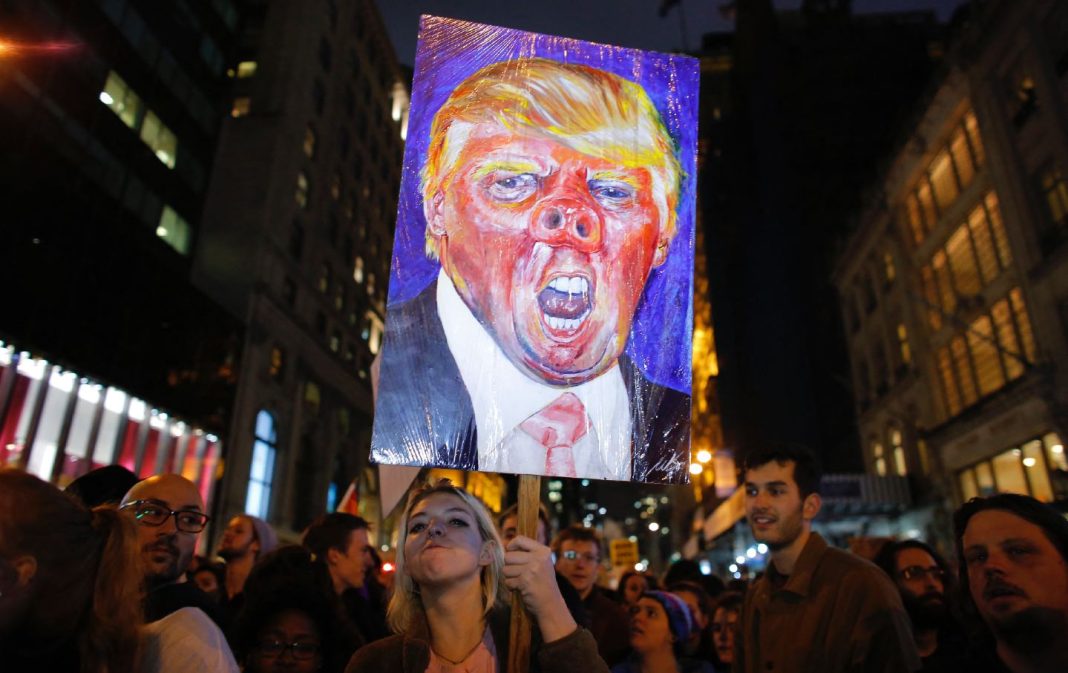
A protest against President-elect Donald Trump in New York City on November 9, 2016.
(Kena Betancur / AFP via Getty Images)
Authoritarians tend not to consider the public purse or the well-being of the public. They regard themselves as the state—modern embodiments of Louis XIV’s “l’État, c’est moi”—and we shouldn’t pretend otherwise. What they do care about is their own wealth, and so they are mindful to nurture the purses of those whose support they rely on to consolidate their power—and protect their fortunes. It’s no accident that corruption and authoritarianism are so often a hand-in-glove combo.
Sometimes, however, authoritarians have the good sense to camouflage their greed behind pronouncements about the public good; that’s been the historical model for, say, the caudillos of Latin American strongman rule.
But in the United States, Trump is even dropping the public bromides. Earlier this week, in what is surely going to feature in every Democratic attack ad between here and the midterms, Trump, in talking about the Iran conflict, blurted the quiet part aloud, telling reporters that he “doesn’t think about Americans’ financial situation” and that this wasn’t even a “little bit” of a factor when considering how to negotiate an end to his war-of-choice with the Iranians.
While creepy Veepy Vance tried to deny that the boss had said what the boss had clearly said, the damage was already done. The president had overtly stated his lack of concern for the pain Americans are feeling because of sky-high gas prices and a broader burst of inflation. It was one of the most bizarre “let them eat cake” moments of this decadent and sunsetting presidency.
Current Issue

While Trump is swanning around telling people he doesn’t care about Americans’ economic hurt, he is also rooting around in the public trough with ever-greater abandon. A few months back, Trump announced a lawsuit against the IRS for $10 billion, for damages purportedly incurred when an independent contractor, back in 2020, leaked details of his tax returns to The New York Times. Most observers believe it to be a frivolous lawsuit of the kind that the Department of Justice, representing the US government, frequently bats away. This time, however, Trump’s shameless DOJ lackeys look like they are negotiating a settlement before it gets to court and a judge has the opportunity to dismiss the case because of the clear conflicts of interest involved. Sources have told CNN and other media outlets that part of the settlement could involve a promise not to audit Trump anymore—a potentially huge windfall given the allegations that he and his companies have repeatedly short-changed the IRS.
Since IRS funds come from taxes, this means that Trump is using his public platform to pressure (one might even say “extort”) the US government to give him taxpayer money. Sure, it’s a bit more subtle than a caudillo and his soldiers raiding the treasury and riding off into the sunset with gold bars, but one doesn’t have to squint too hard into that sunset to see the similarities.
Out of the same mode of corruption-in-broad-daylight comes Trump’s ludicrously offensive pressuring of the Food and Drug Administration and Department of Health and Human Services to grant regulatory carve-outs to big tobacco companies that are hawking various flavors of vapes to US consumers. In essence, the saga goes like this: Big tobacco throws millions of dollars into Trump’s 2024 election campaign and toward a series of post-election vanity projects; Trump then picks up the phone and orders FDA officials to fast-track approval for the sale of these addictive, dangerous products—the marketing for which is primarily aimed at young, easy-to-manipulate consumers; senior FDA and DHHS officials, including FDA commissioner Marty Makary, resign in protest; and Trump’s propaganda outfit then declares that Trump is solely concerned with the well-being of the American people and, in true Orwellian form, puts even more pressure on the DHHS to approve these cancer-causing alternatives to cigarettes.
Then there’s Miami-Dade College transferring prime real estate, potentially worth hundreds of millions of dollars, to the state of Florida so that it could in turn gift it (or rather, “sell” it for $10) to Trump’s library foundation to build his presidential library and museum-cum-resort-hotel. If that doesn’t violate the Emoluments Clause, which prohibits using public office for self-enrichment, then nothing does.
Renditions of the proposed building, complete with the eponymous logo, look remarkably like Trump’s numerous other gaudy, gold-bedecked hotels. And Trump himself has made it clear that he sees the presidential-library project primarily in real estate terms. He wants to rent out expensive hotel rooms to guests and, to satisfy the requirement that this profit machine is actually a nonprofit monument to Trump’s legacy, tuck a small library and museum somewhere in the building’s nether regions. In late March, he even went so far as to tell a reporter, “I don’t believe in building libraries or museums.” (Hardly a surprise for a man who seems never to read or to have the slightest curiosity about culture, art, or history.)
He does, however, believe in erecting, on the grounds of the White House, a UFC fight arena that will come online in time for his Roman Empire–like gladiatorial celebrations of the 250th anniversary of the Republic’s birth, and that major corporations can buy entry into by ponying up $1 million–plus for Trump-promoted causes. (Think of the mad emperors and their wealthy minions, stuffing themselves on the Roman equivalent of popcorn, while watching gladiators bludgeon and stab each other to death.)
If you’re still not convinced that Trump’s presidency is little more than a cash cow for oligarchs, check out the invite list for Trump’s journey to China this week. You’ll see familiar names: Elon Musk, Apple’s Tim Cook, Nvidia’s CEO Jensen Huang, Blackstone’s Steve Schwarzman, as well as top figures from Meta, Boeing, Goldman Sachs, and others.
These economic titans weren’t accompanying Trump to get a good view of the Forbidden City or a satisfying hike along the Great Wall. Rather, they were there to cut deals, ramp up profits, and hawk their vision of an AI-dominated, tech-lord-run global future. This trip wasn’t about securing, or even defining, America’s national interest at a moment of spectacular uncertainty; rather, it was about helping the fat cats get even fatter and shaping the United States’ most important geopolitical relationships over the coming decades in a manner that financially rewards the new techno-elite.
I can’t help but think of that wonderful, disturbing, dystopian Leonard Cohen song, “Everybody Knows,” about how the game is rigged in favor of the rich and powerful:
Everybody knows that the dice are loaded.
Everybody rolls with their fingers crossed.
Everybody knows that the war is over.
Everybody knows that the good guys lost.
Everybody knows the fight was fixed.
The poor stay poor, the rich get rich.
From illegal war on Iran to an inhumane fuel blockade of Cuba, from AI weapons to crypto corruption, this is a time of staggering chaos, cruelty, and violence.
Unlike other publications that parrot the views of authoritarians, billionaires, and corporations, The Nation publishes stories that hold the powerful to account and center the communities too often denied a voice in the national media—stories like the one you’ve just read.
Each day, our journalism cuts through lies and distortions, contextualizes the developments reshaping politics around the globe, and advances progressive ideas that oxygenate our movements and instigate change in the halls of power.
This independent journalism is only possible with the support of our readers. If you want to see more urgent coverage like this, please donate to The Nation today.