



April 8, 2026
Why didn’t Orbán’s government, once a critic of what it called a “bad privatization,” save jobs?
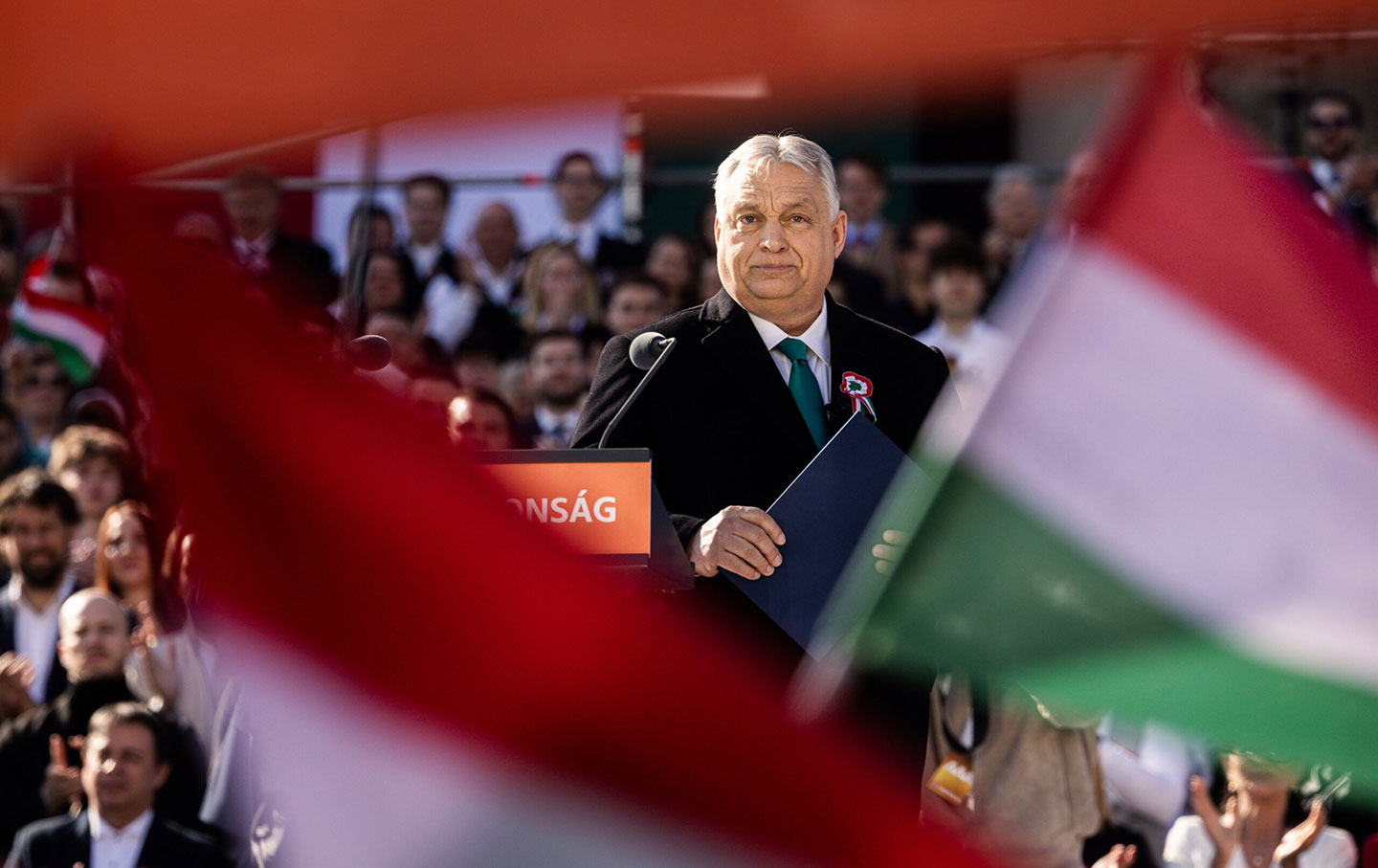
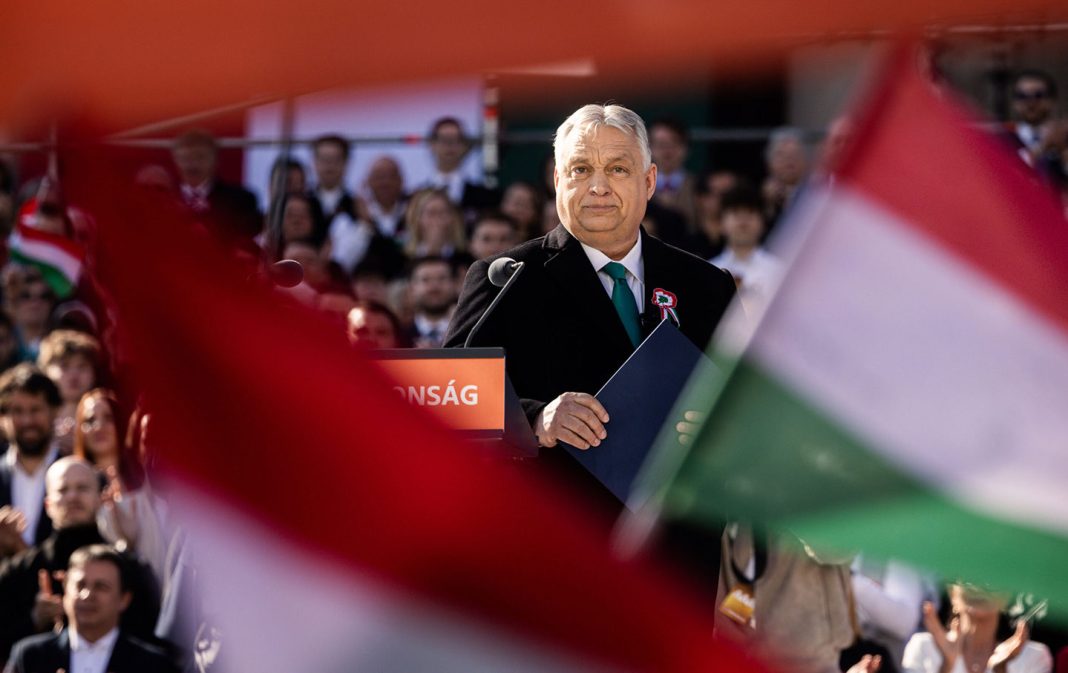
“Icannot imagine a society without people with grease on their hands.” Hungarian premier Viktor Orbán has long called creating a “work-based society” the key to his country’s future. It’s underpinned his distinctive brand of right-wing politics, and inspired the “pro-worker” conservatism touted by figures like Tucker Carlson. Endorsing Orbán ahead of Sunday’s election, Donald Trump likewise stressed his record of job creation.
In Dunaújváros, the contradictions are obvious. Orbán’s brand of state interventionism has not uplifted workers’ position through labor rights or a stronger safety-net, but counted on deals with multinational capital to employ Hungarian workers. In the post-crisis years, this paid off electorally, even if talk of winning economic sovereignty remained a mirage. Yet today, with the war in Ukraine and the ever-escalating conflict in the Middle East, this balancing act is harder to maintain. Ahead of Sunday’s vote, working-class Hungarians may be less convinced to turn out for Orbán.
This story has some truth to it. In the decade after Orbán returned to power in 2010, Hungary’s working population expanded by around 20 percent. Not only did German auto giants build up production here, but a construction boom, plus “workfare” programs, pushed employment rates above the EU average. If stories about “pro-family” policies often cast Hungary as a nation of stay-at-home moms, more Hungarian women are in-work than their EU counterparts. It’s also key to Orbán’s support among Roma people.
Orbán has himself claimed that his hopes of re-election on April 12 depend on workers turning out to vote. His Fidesz party has not just consolidated power by extending its reach over the media and the state apparatus but built real support among wide swathes of the population. Yet, for many Hungarians this rhetoric about a “work-based society” is today losing its luster. It’s a major reason why after Sunday’s election, Orbán, too, may be out of a job.
The End of an Era
To understand this weakness, it’s important to recognize different phases in Orbán’s rule.
Analyst Dávid Karas tells me that in the first years after the 2008 financial crash Fidesz promised to win back Hungary’s “economic sovereignty,” while basing living standards on wages, not borrowing or benefits. Yet reindustrialization remained reliant on foreign direct investment, and preparing a low-cost workforce for multinationals. Orbán’s talk of “greasy hands,” Karas says, was also a retort to opposition claims that the government wasn’t investing in higher education. Blue-collar work offered a way to a “more dignified and stable society than producing jobless and socially useless graduates.”
This low-wage model has, however, stopped earning good grades. As sociologist Ábel Csathó tells me, while Hungarian employment rates rose strongly throughout the 2010s, this progress tapered off since the pandemic. In fact, Hungarian living standards have dropped to the lowest in the European Union. Faced with the current war in Iran, shocks like rising gas prices may further threaten Hungary’s future as a global industrial hub.
Current Issue
Some weaknesses of this model were visible even earlier, as shown by events in Dunaújváros, long one of Hungary’s main industrial centers. The story of its historic steelworks, which closed in 2024, shows how the Orbán government allowed multinational owners to wreck a major strategic industry, letting it go to the wall even as it pledged to save jobs.
Steel City
Iheaded to Dunaújváros on a Saturday, three weeks before the election. A postwar new town, its streets follow a grid pattern, reaching a sudden, steep halt above the Danube. When it began construction in 1950, it was called Sztálinvarós, in tribute to the Soviet leader, but the nationwide revolt in 1956 also shook this socialist model town. Five years later, it took its current name, meaning New Danube City; today, its Lenin statue is banished to the local museum’s back courtyard. But the steelworks created back then still shape local identity.
Csathó introduces me to former steelworker Isztán Nagy. He remembers exactly when he started work: “September 2, 1971.” Soon after he began as a production worker, the steelworks enrolled him on a college economics course. Nagy tells me that it had a “highly liberal,” US-inspired program, with the kind of pro-market ideas spread by economists like János Kornai. Talk of profitability reshaped Hungarian socialism long before it met its end in 1989.
Nagy stresses that the vast steel complex, from 1984 titled Dunaferr, was always the heart of this town. Local sports teams took its name, and in 2000 Dunaferr soccer club won the Hungarian premiership. Today, the club, too, has gone bust. Dive bars lined up outside the old steelworks gates now pine for lost battalions of worker-drinkers.
It’s not all Orbán’s fault; and for some, job losses came well before the final 2024 shutdown. Even in the late-Communist era, the plant introduced profitability measures that cut jobs, albeit without heading for full privatization. Nagy speaks of redundancies as a process negotiated with strong unions, also counting on a fund to cushion layoffs. From 1996, longtime employee Nagy—by then a local Social-Democrat leader—sat on the company board. He says Orbán’s first term from 1998 to 2002 meant political interference, changing the plant’s management and pressuring it to use dolomite supplies from mines controlled by Orbán’s father.
If this stirred resentment, the plant’s fate also helps explain why local workers didn’t stick with the political left. It was a Social Democrat–led government, in alliance with neoliberal hawks, that finalized the privatization of the plant in 2003—despite, Nagy says, the local party’s attitude. The new owners were, he explains, Ukrainian, but also bound up with a Russian bank, and the conflict between the two caused problems which exploded when war broke out in 2022.
But why didn’t Orbán’s government, once a critic of what it called a “bad privatization,” save jobs?
Orbán Visit
The Thursday night before I visited, Orbán held a national rally in Dunaújváros. Haranguing the plaza in front of the local cinema, he tried to outdo an earlier event here by the main opposition leader Péter Magyar. Countless Fidesz posters here show a grim-faced Magyar alongside EU Commission President Ursula von der Leyen and Ukrainian President Volodymyr Zelenskyy. The ruling party’s message: Magyar won’t put Hungary first.
Popular
“swipe left below to view more authors”Swipe →
Asked, ahead of his visit to Dunaújvaros, why the steel plant went bust, Orbán reportedly told one local paper that “the decisive reason is the Russian-Ukrainian war, the sanctions policy and the EU’s poorly designed green industry concept.” Yet, in his town-square rally Orbán avoided all reference to the Dunaferr job losses. If this past fall, the government promised to revive production, the prime minister’s silence was hardly a vote of confidence. The crowd for this Dunaújváros rally, several locals pointed out, owed less to pro-Orbán residents than to Fidesz supporters bussed in from surrounding villages.
So, is Orbán’s election campaign distracting from local economic woes by turning attention to geopolitics? According to former Dunaferr employee Erika Kaiser, the issues sound more intertwined, though not in a way that does Orbán much credit. The Ukrainian owners from 2003 were the Donbas Industrial Union, based in Donetsk—another steel city formerly named after Stalin. Yet, hit by the financial crisis, in 2010 this owner entered a partnership with a Russian bank, VEB. Kaiser tells me that it was hard for locals to tell who was really in charge, and in its final years it didn’t file proper financial statements. This was, she says, a “chaotic legal situation” but government failed to step in.
One member of the VEB supervisory board was Vladimir Putin, who reportedly discussed the plant’s future with Orbán in 2014. In the first years after the buyout, Kaiser explains, the Donbas-based company could produce a semi-finished product cheaply on home soil, before final processing in this Hungarian, thus EU-based facility. The civil war in eastern Ukraine from 2014, and the destruction of the owners’ property there, probably made the firm more reliant on its Hungarian operations. Yet, investment was also lacking. The two furnaces needed routine replacement, but only one was replaced, after repeated delay.
When Russia invaded Ukraine in 2022, there were still 4,500 steelworks jobs at Dunaferr, but the firm was building up legal problems. Later reports claim that the subsidiary in charge of the plant failed to cover €655 million in EU-level carbon credits and fines, before Dunaferr part-halted production in September 2022. Initiating liquidation proceedings that December, Orbán’s government pledged to step in and preserve the industry. It offered not to nationalize the plant but to ensure the workers’ future under another owner.
This was a promise it couldn’t keep.
Liberty
In summer 2023, the government chose British-Indian Liberty Steel, one of four bidders, as the buyer. Official media boasted that the government had “saved” the steelworks, a “top priority” in this “strategic sector.” But Liberty was a puzzling choice, deputy mayor Zsolt Szabó tells me, given its already “existing financial problems; it was known across Europe that they’d bought multiple companies but didn’t have enough money to operate them.” Kaiser concurs that Liberty had a track record of buying industries that could benefit from state subsidies but had not fulfilled its commitments on investment.
The buyout promised to save jobs at Dunaújváros, perhaps by converting production. Liberty pledged to renew the plant by building two electric-arc furnaces, so that steel from Dunaferr could be adapted to auto manufacture, and—a field of investment now rising in Europe—military industries. In September 2023, Liberty announced that it had Chinese backing to carry through a major decarbonization of the plant. Yet concrete measures were lacking, and the government again turned toward bankruptcy proceedings.
What is the political fallout? Kaiser suggests that local employees may credit the government for ensuring that their wages were paid for months after production halted, but ultimately blame it for choosing Liberty Steel as the buyer. This compounded its failure to control irregularities under the previous owners, and made eventual recovery even more expensive. Szabó stresses that city hall—headed by an opposition, anti-Orbán coalition since 2019—tried to give the steelworks leeway on tax payments, and that this also helped ensure that wages got paid. But in June 2024 the coke ovens were turned off for the last time.
Szabó insists that the ruling party’s promises were far from reality. “When the steel plant was still operating in 2022, the current [local Fidesz] representative, holding a shovel at the factory, said he would save it. Then, two years later, people were standing in line in the scorching heat waiting for their termination notices.” He suggests that although the government had the opportunity to seek financial support from the European Union to save a plant of this scale, it failed to do so, which led the Dunaújváros municipality to take matters into its own hands and begin participating directly in EU funding applications.
Szabó was initially a local candidate in the April 12 general election, before withdrawing in favor of main opposition force Tisza; his campaign literature refers to steel as part of Dunaújváros’s “way of life.” Yet, in our conversation, even talk of potential EU aid now seems aimed at adaptation for a post-steelworks reality, and retraining schemes for local employees. Highlighting the mental-health effect of the layoffs, Szabó explains that for many workers in their 40s and 50s, this may be tougher.
Dunaújváros doesn’t rely on steel alone: It has a major site for South Korean tire firm Hankook, and serves as a base for employees commuting to Budapest. But even further afield, there are many clouds over Hungarian industry. The government jobs strategy has in recent years counted heavily on making batteries for electric vehicles, but as Karas explains, this has heightened its dependence on foreign capital. There are even reports of Chinese electric carmaker BYD bringing in lower-paid—and ill-treated—migrant labor rather than employing Hungarians at its new site in Szeged.
More from The Nation
With the illusion shattered, now is the chance for the US to liberate itself from a broken imperial model.
The brutal Gulf monarchy has been cheerleading Trump’s insane war off-stage but won’t commit to any direct role in the conflict
The pontiff’s Easter address, like so many of his recent statements, countered Trump’s Iran bombast with a cry for peace—and sanity.
All this we heard in 2003, and all this we are hearing again now.