


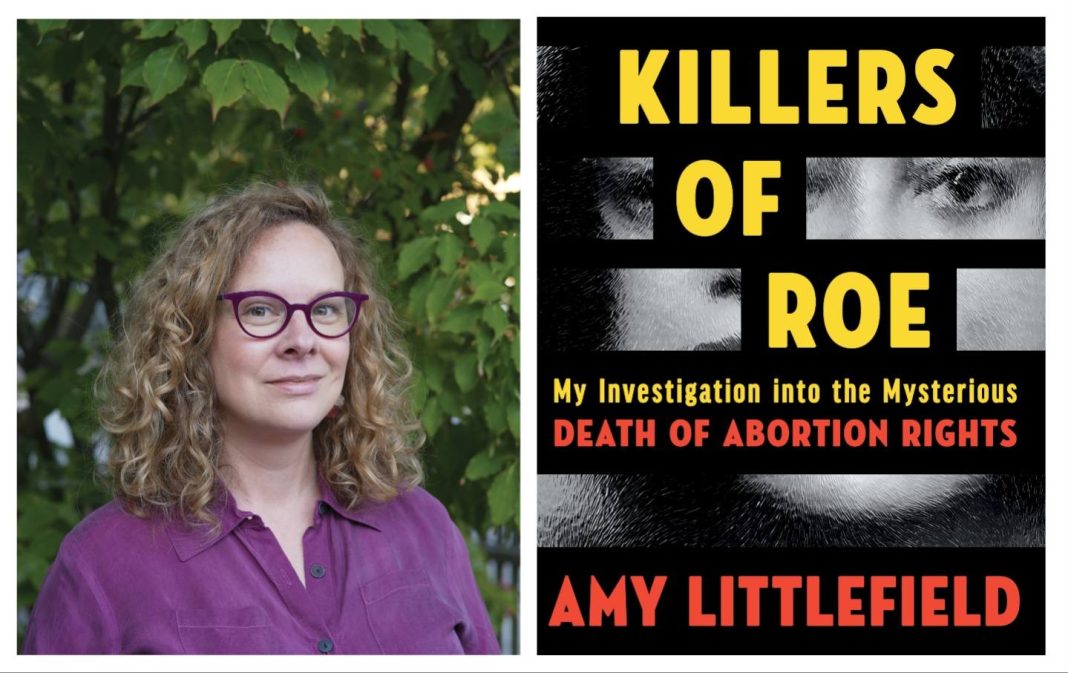

Abortion access reporter Amy Littlefield’s new book reports on the grassroots social movement that amassed enough power to overturn legal abortion, despite being a minority point of view.
When the Supreme Court lurched rightward in the wake of Ruth Bader Ginsburg’s death, veteran reproductive rights reporter Amy Littlefield knew what was coming: there were now enough conservative votes to overturn Roe v. Wade. Sure enough, under two years later, the Court revoked the constitutional right to abortion, paving the way for 13 states to ban the procedure entirely. Littlefield’s new book, Killers of Roe, investigates the decades-long effort to end legal abortion via an unlikely angle: the book is framed as a whodunit, setting out to track down the culprit responsible for overturning legal abortion and discern how they succeeded when the right had always held most Americans’ support. From the Roe v. Wade turning point in 1973 to its dismantling nearly 50 years later, Littlefield’s book offers an account of the anti-choice movement’s rise, and the amalgam of political tactics and righteous belief that undergird it. The contradictions that emerge as Littlefield probes this “spiritual civil war” demand nuance in what can otherwise seem like a coldly polarized dispute: Nancy Reagan was quietly pro-choice, former Republican Senator Bob Packwood was a womanizer who “cared about abortion rights, even as he took advantage of women’s lower social status.” Littlefield surveys fractures within the pro-choice movement, too: Frances Kissling, the former head of Catholics for Choice and otherwise on Littlefield’s “side,” questions the use of gender-inclusive language when talking about abortion. Her investigation becomes a character study in the interests of broader historical revelation: As she awaits Roger Craver, the pioneer of progressive organizations’ direct mail programs that historians have argued led to a focus on issues most relevant to the donor class, Littlefield writes, “I felt as if I was about to confront not just a person, but a phenomenon.”
That tension of scope between the role of individuals and structures is one Littlefield takes on with an inveterate reporter’s mind: She calls politicians to account for the legislation they’ve collectively effected; fits specific victims like Rosie Jimenez into a broader exposé of abortion as fundamentally a class issue; channels her own bursts of anger into the energy of the pro-choice movement at large. She finds footholds in the granularity of one-on-one meetings with anti-choice figureheads — and even a skinny-dip in Mexico with Kissling — to draw out decades of political meaning. In writing this book, Littlefield told me, she investigated anti-abortion luminaries as suspects in the format of a thriller — accessible like the mysteries that have always brought her satisfaction and comfort. She called into this interview from a lactation room in Baltimore, and hung up to find a fellow nursing mom had left her a business card scrawled with a thank you. —Sophie Mann-Shafir
SMS: What did writing this book make you think about how and why Roe was overturned? Is there a single answer?
AL: I think it’s a complicated, multi-layered answer. A lot of us who have covered this topic understand that the balance of power on the Supreme Court and the legal organizing work of groups like Alliance Defending Freedom played a huge role at the macro level. But I was interested in digging into the more grassroots level to examine the behind-the-scenes figures that you haven’t heard of. I think one of the tough realities to confront as someone who supports the right to abortion is that abortion opponents built an incredibly impressive grassroots social movement, and they did so even though they represented a minority point of view. Pretty quickly after Roe v Wade happened, more people supported legal abortion than not. And yet, despite holding a minority viewpoint, this movement succeeded in the monumental victory of overturning a constitutional right. And they did so because of the famous strategists and Supreme Court justices, but also because of quieter people in the shadows.
SMS: Did you have to shift the way that you thought about abortion opponents as you sat across from pioneers of the anti-abortion movement?
AL: In almost every interview I conducted, there was a moment when the person I was talking to, after I asked them about their motivations, would say some version of, “Well, I hope when I get to the gates of heaven, the work that I’ve done against abortion causes me to get a ticket in.” I heard it first from this man named Paul Haring, who played an early role in the Hyde Amendment, first passed in 1976, which banned federal funding of abortion. He was trying to convert me to Catholicism, so for him, it was like an elevator pitch.
Current Issue

I’d been thinking of the alliance that brought about the end of Roe as a collaboration between believers and opportunists. There were times when there was so much discussion of heaven that the lines began to blur, and the believers seemed to be seeking the greatest opportunity of all, which is eternal life.
SMS: Let’s talk about how you chose to frame your book. We more commonly encounter charges of murder deployed by the right — which generally considers abortion and even emergency contraception to be murder. Can you talk about your choice to use this framework from such a different political angle?
AL: It started out because I was a new mom when Ruth Bader Ginsburg died, and I understood that Roe was going to fall not long after. I had been covering abortion access and the slow, incremental decimation of abortion access for many years at that point, so I knew it was coming, and I knew that people were going to die as a result. At the time, in this fog of new motherhood mixed with anger about the erosion of abortion rights, about the only media I could consume was murder mysteries, which had been my comfort when I was a teenager, too. So that format began as a way for me to entice myself to tell a really challenging story.
I am also trying to play with flipping the script on anti-abortion folks, who talk about people who support the right to abortion as murderers. I’m trying to look at the question of what responsibility the proponents of these policies bear for people who have died as a result of their policies, whether we’re talking about Rosie Jimenez, who died in the 1970s, Becky Bell in the 1980s, or moving forward to today, with all of the women whose deaths have been reported by ProPublica.
SMS: What did your research make you think about what those responsibilities are? Did any kind of revelation come from talking to the “culprits”?
AL: I was pretty taken aback by the level of denial from the men I talked to who were involved in these policies, and the ways that they managed to decline responsibility: to shift the blame onto doctors or onto the women themselves, and to deny that these abortion bans had anything to do with deaths that resulted pretty clearly and directly from anti-abortion policies. I tried to follow the murder mystery format, where there’s some dramatic resolution, where you get the sense that the person feels bad about what they did. The killer repents or expresses remorse, or they’re dragged away in handcuffs. In real life, it turns out that doesn’t happen. There’s no justice for the killers of Roe. There’s no big moment of dramatic confession over any of these preventable deaths of women who died from anti-abortion policies, although I tried my best to get one.
Popular
“swipe left below to view more authors”Swipe →
SMS: You connect anti-abortion legislation to decades of forced sterilization campaigns against people of color, beginning in the early 1900s and lasting into the 80s. They’re somewhat opposite practices, but they’re both fundamentally about control of people’s bodies. The US has a notorious track record of infringing on the liberties of some while protecting others’. How do you conceive of the anti-choice movement relating to other US power structures?
AL: I use the Hyde Amendment as sort of a Rosetta Stone to talk about the intersection of racism, classism, and sexism, and restrictions on abortion. They all come together in that policy, which was about abortion opponents understanding they couldn’t ban abortion for everyone — that wasn’t politically possible. So, they were going to ban it for poor people, who were disproportionately women of color. I talk about how the word “taxpayer” did a lot of heavy lifting in that debate. “Taxpayer” has always meant the right of white men not to have to pay for things that women of color need to survive, abortion being one of them. I saw that word as a red herring that recurred frequently in this history, including around justifications that were used for the forced sterilization of women of color. That, of course, is crucially tied into this history, because it’s also about infringements on bodily autonomy.
SMS: You write about politicians’ wishy-washiness when it comes to abortion, like Reagan and Biden and Trump. Do you perceive those changing stances as an actual change in belief or strategy?
AL: When you look at the shifting loyalties of Democratic and Republican politicians alike on abortion, it’s often been a matter of political opportunity — Donald Trump being only the most recent and dramatic example. He’s someone who once declared himself to be “very pro-choice,” and who then appointed the Supreme Court justices who overturned Roe v Wade. And now, to the frustration of anti-abortion activists, he isn’t acting as quickly as they would like to stop the mailing of abortion pills at home.
In some of the internal records that I found — communications between the Reagan campaign and anti-abortion groups — his campaign understood that it was a minority point of view, but they had a crucial contingent of people who were willing to vote on a single issue of abortion. They figured out how to mobilize that contingent to elect Republicans and build this alliance that got Republican politicians interested in the cause. I document this manufacture of abortion as a political cause, especially in the late 70s and 80s.
SMS: Apropos that successful manufacturing, you document a disagreement with Frances Kissling, former president of Catholics for Choice, over the reasons for the pro-choice movement’s struggles and defeats. She thinks it’s been too bold; you think not bold enough. What does the pro-choice movement have to learn from the anti-abortion movement?
AL: One thing is learning to be bold and incremental at the same time. The anti-choice side was incredibly radical in some ways, and very patient and strategic in other ways. They had groups that were working incrementally through the courts, and then groups like Operation Rescue that were blockading clinics, making abortion a stigmatized and controversial thing, even though it’s long been popularly supported.
And as a result, often the Overton window was drawn to the right. That’s why the example of All Above All, and the movement to repeal the Hyde Amendment, is such a hopeful example. They really pushed the Overton window to the left on the question of public funding of abortion, which had been so stigmatized for so long. Even within the pro-choice movement and among Democratic politicians, there were a lot of doubters asking why you would you touch this third rail, why you would talk about public funding. They had just come through a bruising fight over the Affordable Care Act, and Republicans were calling that policy socialism. It was like, didn’t we just resolve this? I think the result is that we need to change the way that we think about and talk about that issue.
SMS: You spent a lot of time face-to-face with anti-choice advocates, not finding the neat murder mystery denouement of confession or resolution. Where did that leave you thinking about hope for common cause, or hope at all, moving forward?
AL: I think it looks like people making justice for themselves, and I think we’re actually in a really difficult and yet hopeful moment for that process. There are anti-abortion culprits like Monica Migliorino Miller, who stored fetuses in her closet and still does stints in jail for her activism. But those people exist on the right side of history too, and they’re really having a moment right now. I think about Minneapolis, moms and dads driving minivans and filming federal agents out the window — all those who are doing the quiet and deliberate work of justice. There was a new momentum to those efforts within the abortion rights movement in the wake of the Dobbs decision. One of the most meaningful forms of activism that I see is the way that medical providers protected by shield laws in blue states are mailing abortion pills into states where abortion is banned, at great personal risk. I think in the absence of big, dramatic moments where the detective delivers a sense of justice, grassroots activists have found ways to make it for themselves.
Even before February 28, the reasons for Donald Trump’s imploding approval rating were abundantly clear: untrammeled corruption and personal enrichment to the tune of billions of dollars during an affordability crisis, a foreign policy guided only by his own derelict sense of morality, and the deployment of a murderous campaign of occupation, detention, and deportation on American streets.
Now an undeclared, unauthorized, unpopular, and unconstitutional war of aggression against Iran has spread like wildfire through the region and into Europe. A new “forever war”—with an ever-increasing likelihood of American troops on the ground—may very well be upon us.
As we’ve seen over and over, this administration uses lies, misdirection, and attempts to flood the zone to justify its abuses of power at home and abroad. Just as Trump, Marco Rubio, and Pete Hegseth offer erratic and contradictory rationales for the attacks on Iran, the administration is also spreading the lie that the upcoming midterm elections are under threat from noncitizens on voter rolls. When these lies go unchecked, they become the basis for further authoritarian encroachment and war.
In these dark times, independent journalism is uniquely able to uncover the falsehoods that threaten our republic—and civilians around the world—and shine a bright light on the truth.
The Nation’s experienced team of writers, editors, and fact-checkers understands the scale of what we’re up against and the urgency with which we have to act. That’s why we’re publishing critical reporting and analysis of the war on Iran, ICE violence at home, new forms of voter suppression emerging in the courts, and much more.
But this journalism is possible only with your support.
This March, The Nation needs to raise $50,000 to ensure that we have the resources for reporting and analysis that sets the record straight and empowers people of conscience to organize. Will you donate today?
More from The Nation

Alaska’s last great race has struggled to keep up its finances and increase participation. Now, a $300,000 gift from an “expedition musher” promises to transform the event.
The neighborhood is facing an onslaught of catastrophic projects that could be more damaging than Hurricane Katrina.

I left academia for a tech job that offered me the promise of stability. What happens when corporate employers become our most reliable caregivers?
Universities are raising their tuition, offering fewer classes, and axing extracurricular programs to compensate for the dip in international student enrollment.

A jury finds big tech liable for programming addictive features into platforms—and that’s basically the business model for companion bots.
Laura Flanders speaks with Faiz Shakir and John Cassidy on the grassroots fight against the AI oligarchs.